Yeast is used in alot of food and drink. It is used to make some of my favorite drinks, beer and whiskey.
I started engineering Yeast about 1.5 years ago. I thought it would be a useful skill to have in general and as I moved more towards running The ODIN fulltime I wanted to be able to have some yeast strains and experiments on the site.
My first ever attempt to genetically engineer yeast was a success(I used the Lithium Acetate method). I don't know how? because I didn't use SS DNA and probably used like 400ng of plasmid.
My 2nd - 10th attempts I think failed, hah.
I eventually figured out how incubation time at 42-43C matters much more than it does in bacteria and many more things and had it working again. YAY! I don't mind yeast much and almost prefer it to bacteria now.
The other part of this story is Nick Moench, who runs Inoculum Ale Works. He sent me some emails(they were loooonnggg) about how he ran his own brewery in Florida and was interested in Engineering yeast to do cool things. At the time it was just me doing ODIN stuff so I didn't have much time or money to do anything and I think we had a few emails. He almost appeared on our now maybe defunct video cast.
I guess I half-hearted thought about making beers and stuff but as I
preferred to drink with the least effort possible, i.e. purchase the
alcohol. I didn't think much about it. Eventually some other people
started helping out with The ODIN and we ran a few preliminary experiments on fermentation using Saccharomyces cereveisiae
BY4742. To us non-brewers, we were excited when we could grow GFP yeast in
grape juice and still see the fluorescence, days or weeks later.
Nick and I had been chatting on facebook and I brought up how we had grown some genetically engineered labs strains of yeast and that they glow green in grape juice even after weeks. He was interested and excited. He wanted to brew some beer. Unfortunately, as non-brewers we didn't really know what went into brewing beer. We sent Nick the strain and it failed, miserably. I think Nick thought it was his fault, only for us to discover that one of the most abundant sugars in beer(maltose) couldn't be processed by most yeast lab strains(S288C derivatives have knock-outs for enzymes that import(I think) and degrade maltose, this includes BY474(1|2), W303, &c). Also, there are other things that are important like attenuation and flocculation of the yeast that helps make a good beer that brewing strains are selected for.
Sad. But not heart broken. There are plenty of brewers strains of yeast that can process maltose. Problem is that they are not auxotrophic so normal yeast plasmids would be difficult to use and select for.
We tried a bunch of different engineering methods with a bunch of failures. Nick tried his best to nurse the lab strains in hopes that he could coax them into making a beer, almost. We both run businesses and have many other projects but it was cool having someone who actually wants to DO stuff and not just talk about it.
GFP beer like GFP yogurt is one of those fabled things that Biohackers have been talking about since Biohacking started and you can find many blog posts, writings or articles about people's theorizing about it. It's funny because at UChicago(where I did my Ph.D.), one of the many unofficial mottos is "That's all well and good in practice but how does it work in theory."(Scientists and scholars love to theorize, especially at UChicago). That is an interesting and sometimes fun part of Science but in the end if we all just theorize nothing will actually ever be accomplished. Why I hate business meetings and shit also. Let's stop talking about it and just do it. Show me what you got, I want to see what you got. Even if something is not completely planned out I have learned that sometimes you just need to say "Fuck it!" and try something out and see if it works.
We already knew that the GFP could fluoresce in sedimented yeast cells at low pH for weeks(months maybe) at a time. So I read and read some more and I know more about yeast than I wanted to(my brain-drive is already pretty full).
We manage to engineer yeast and Nick, had us run a bunch of experiments and we started working with the yeast and then he created some beer.
During fermentation you can see the glow of Green Fluorescent Protein (GFP) especially when the yeast flocculates or sediments. It is more difficult but still possible to see in bottled beer but it will require some more testing to make it a more consumer product if we eventually go that route.
People ask what it tastes like. Mostly, it just tastes like whatever you are brewing it to taste like. Nick's Brewery brews sours. So it has had a sours taste to it. We try and have some yeast sediment in there meaning there is a more yeasty taste than normal to it but otherwise there is not much in terms of flavours to discern the GFP! We debuted it at the New Harvest Conference, yesterday(July 13, 2016) and everyone was excited to try it and was excited about it!
I guess GFP yogurt is next.
Thursday, July 14, 2016
Tuesday, July 5, 2016
I transplanted someone else's microbiome in(on)to my body and it was so surreal - Results - Part III
This is a case study of a 35 year old caucasian Male of European ancestry living in the United States, a maternal Haplogroup of H1e1a and a paternal haplogroup of I1*. NOD2 Genotype SNP(rs2066844) CC indicating decreased risk of Crohn’s disease. The subject presented with increased bowel movements(3+ times a day) Bristol type stool 5-7, mainly 6. Blood in stool more than 2 but less than 5 times a month. Experiences nausea, abdominal cramps and pain 2 or more days a week with no correlated inducers besides stress. Diet consists mainly of rice, vegetables and meat protein(chicken or pork). Eats out 1-2 times per week. Average kilocalories consumed per day ~2100. Height 5’9”(1.75 m) weight before experiment 167 lbs (76 kg). Exercises 1-2 days per week. Subject also presents with type II bipolar disorder and takes clonazepam as needed to help sleep. Subject has chronic sinusitis with no clear cause and has been tested for allergies and nasal polyps both coming back negative or inconclusive. Subject has been diagnosed with chronic prostatitis and was treated with ciprofloxacin and then bactrim in Dec. 2013(also last time antibiotics were taken) which did not relieve symptoms. Acute symptoms resolved to mild pain during urination.
The subject attempted a full body microbial transplant from a healthy donor Male caucasian ~30 year of age using fresh stool samples, skin, mouth and nasal swabs. Bacterial swabs were taken from, skin, mouth, nose, poop and environment before and throughout the experiment using sterile swabs and stored in 150mM NaCl and 0.01% Tween.
The subject self treated with 500 mg Tetracycline and 500 mg Ciprofloxacin, four doses over 2.5 days. Subject also performed a complete body scrub with soap and tetracycline, including a nasal rinse. The subject proceeded to stay in a precleaned hotel room using new untouched sheets. The subject did not touch another person during the course of the transplant without the use of nitrile gloves. The subject stayed in the hotel room for 3 days and 3 nights during which he ingest 3-6 grams of donor feces enclosed in gelatin pills. He coated himself with 20-50mL saline solution containing swabs from the donors skin. He also inoculated his mouth and nasal passages no less than 6 times with the donors swabs. Patient returned home and attempted to clean and sterilize ~700 sq ft (65 sq m) apartment and inoculate it with donor skin bacterial cultures.
Within one week of the experiment the subject’s bowel movements were consistently reduced to 1 time per day. Stomach pains and cramps reduced almost completely within 2 weeks. Subjects weight reduce to an average of ~ 160 lbs(73 kg) 2 months after the experiment. Diet has remained very similar(rice, veg, meat) except subject notices more meat(no craving) and a newfound craving for sugary foods. Prostatitis resolved completely. Symptoms from post nasal drip seem reduced but uncertain, symptoms still flare up at least 2-5 times a month. Bipolar disorder not affected.
A total of 77 samples were collected before, during and after experiment. DNA extraction, 16s amplicon library prep using 515f and 806r and Illumina MiSeq 151x151 sequencing was done by Argonne National Lab in Batavia Illinois. Of the 77 samples 73 had counts.
Data Analysis
QIIME 1.9.1 was used for data analysis
Samples 65(storage buffer) and 66(storage buffer and sterile swab) were control samples and used to filter out contamination using standard QIIME workflow. Afterward sample #55 had below 1000 counts and so was removed from the rest of the study.
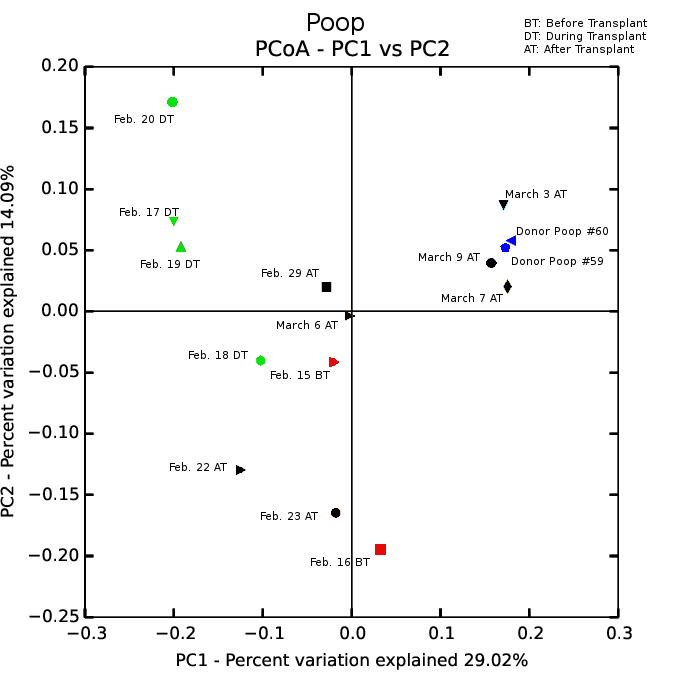
Beta diversity was calculated for poop samples using a jacknifed subset of 5000 sequences. PCoA plots of weighted UniFrac are displayed below.
Less than two weeks after the transplant the microbiota in the gut of the subject became more closely related to the donors gut microbiota than to the subjects gut microbiota before the experiment.
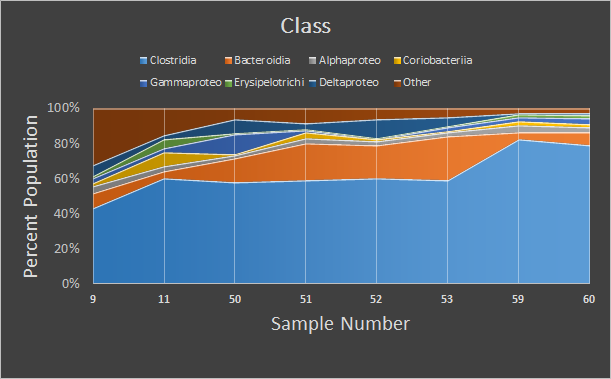
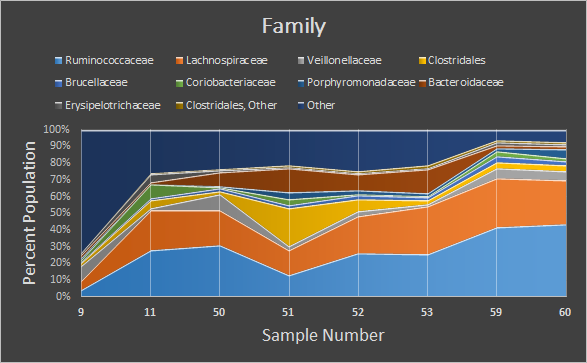
Observing the different types of bacteria in the samples both on the Class and Family levels, the subjects gut had increased diversity before the transplant (#9 and #11) as compared to after the transplant (50, 51, 52, 53) and had more similar diversity to the donor’s samples (59, 60). Diversity was insinuated by the portion of a sample belonging to species other than those the top 10-15 samples, Shown by "Other".
Saturday, May 7, 2016
I transplanted someone else's microbiome in(on)to my body and it was so surreal - Part II
You can follow along Here for my daily questionaire and Here there is a diary near the bottom
Tuesday Feb 16th - Antibiotics Day One, Experiment Day One
The first day I would be taking antibiotics. Didn't sleep much the night before or the night before that. Stress can induce mania in me. It doesn't take much these days to give me the adrenaline of skydiver. The strange thing is I usually have no problem falling asleep, I just end up waking up some hours later and no matter how hard I try can't go back to sleep.
The plan was to take 500mg Tetracycline and 500mg Cirpofloxacin, both broad spectrum antibiotics that target different proteins in bacteria to increase my chances of wiping out as much bacteria as possible. Tetracycline tastes like sour acrid sulfur, pretty awful. If you think the Malort face was bad the Tetracycline face is worse. I weighed out 500mg and mixed it with water and took it as a shot. I had some ciprofloxacin in pill form so it wasn't nearly as bad.
The diarrhea that came after was bad but I had expected as much. As anyone who has taken a significant dose of antibiotics before knows, you get the shits.
My chess rating on chess.com began dropping. Dahhhh, this usually happens when I am preoccupied and have a hard time focusing. It is a pretty good measure of my mental acuity. Also, because my stomach was messed up I wasn't consuming alot of calories which definitely messes with my mental acuity. In fact I only consumed 1000 calories on Feb. 16th!! Yikes. I generally need around 1800 to 2000 calories to perform well on memory tests and chess.
Wednesday Feb 17th - Antibiotics Day Two, Experiment Day Two
My stomach was pretty upset by this time I was also feeling pretty loopy. Unfortunately, it was time to go to the donor's place and pick up the samples for the transplant. I wanted them to be fresh for the transplant tomorrow. I told the donor to try and not eat anything crazy or abnormal the night before.
Fortunately, I had someone to drive me to the donor's place. By this time I was pretty out of it. The donor gave me a pretty hefty fecal sample in a plastic bag fresh from this morning. Then I made him take significant swabs of his arms, legs, mouth and nasal passages that I stored in 150mM NaCl. These would be used to inoculate my arms, legs, mouth and nasal passages. During the experiment I stored all the samples at ~4C in the fridge.
I took two doses of antibiotics today, still had diarrhea and still was having trouble eating much but better than yesterday at 1200 calories, chess score still suffering.
Because I didn't feel tired and hadn't slept much in two days I took 1mg of clonozepam to help me sleep and I accomplished an amazing 6 hours.... Usually, if I can get at least some sleep it keeps me from being manic. Mania for me is compounding, the less I sleep the more manic I become and the less I sleep. To help abate the cycle I take medication that helps me sleep. Sometimes this doesn't work and is insanely annoying
Thursday Feb 18th - Antibiotics End, Hotel Room Day One, Experiment Day Three
Still on the antibiotics but moved to the hotel room on Thursday, with my chess rating still suffering, down from 1425 before to 1393 today. The experiment has already started to become surreal but today it took it to a whole new level.
Once in the hotel room, I strip down to my boxers and put on booties, gloves and gown and start cleaning. I use disinfectant wipes and spray to clean most areas of the hotel room I would feasibly touch. I took bed sheets I purchased from amazon, still in packing and placed them over the hotel bed sheets and used pillow cases from amazon over the hotels. Anyone who entered the hotel room had to wear booties and if they planned on touching stuff, gloves. There was also a separate bed in the room that I never touched that they could sit on or lay on.
Then it was time. I went in the shower and cleaned myself and then started scrubbing myself using a sponge and antibiotics. My goal to wipe my microbiome completely off and out of my body before the transplant. For about 1 to 1.5 hours I scrubbed ever crevice and part of my body. Alot of people suggest it is impossible to remove all microbes from your body or that you would die if you did or any other number of insane hypotheses. It's possible but I didn't think likely. And though I didn't imagine I could remove every microbe I really wanted to try. Sadly, I only remembered to take microbiome samples before the cleaning and didn't really take any at all on the 19th because I was feeling so strange and out of it and just forgot.
At 1730 I took my first FMT pills and performed by first skin, mouth and nasal inoculations.
I did it again a few hours later.
I wanted the end of my antibiotics to overlap with the start of transplant so that the new bacteria had overwhelming numbers on and in my body.
I put on a white t-shirt I purchased from amazon. I put on underwear from amazon and a pair of laundered jeans while people were around. The Verge mention the laundered jeans as strange instead of just having purchased some new ones from amazon. How much different would the bacteria be on a new pair of jeans versus an old laundered pair of jeans? I don't know, maybe there would be a significant difference but I imagined not so. I also imagined not wearing pants much(I only really wore them when people came to my room).
I think in probabilities and some people think in exactitudes. What would the probability be that an old laundered pair of pants would effect the outcome versus a new pair of pants. In my opinion it was very small to none. I call it reason.
Friday Feb 19th - Hotel Room Day Two, Experiment Day Three
I ordered some take-out and chilled. I had heartburn all day but was refraining from taking an antacids because I didn't want them to mess with my gut. I actually was starting to relax and regain some of my normalcy as can be seen by my chess rating increasing and my calorie intake was also up. I enjoy staying in hotels because I don't have cable or network TV at home and it is great to watch old movies.
Saturday Feb 20th - Hotel Room Day Three, Experiment Day Four
I haven't taken a shower since he transplant started and I have been rubbing bacteria all over my body. Heartburn was getting to me and sitting in the same bed and not really leaving the hotel room was really getting to me. I was mentally and physically exhausted.
Sunday Feb 21st - Hotel Room Day Four, Experiment Day Five
I finally get to go home. When I arrived home I cleaned the apartment and put new sheets on the bed and the coverings on the couch were laundered. I rubbed my skin all over the bed and the couch to try and populate them with my new microbiome and then I took a shower.
Tuesday Feb 16th - Antibiotics Day One, Experiment Day One
The first day I would be taking antibiotics. Didn't sleep much the night before or the night before that. Stress can induce mania in me. It doesn't take much these days to give me the adrenaline of skydiver. The strange thing is I usually have no problem falling asleep, I just end up waking up some hours later and no matter how hard I try can't go back to sleep.
The plan was to take 500mg Tetracycline and 500mg Cirpofloxacin, both broad spectrum antibiotics that target different proteins in bacteria to increase my chances of wiping out as much bacteria as possible. Tetracycline tastes like sour acrid sulfur, pretty awful. If you think the Malort face was bad the Tetracycline face is worse. I weighed out 500mg and mixed it with water and took it as a shot. I had some ciprofloxacin in pill form so it wasn't nearly as bad.
The diarrhea that came after was bad but I had expected as much. As anyone who has taken a significant dose of antibiotics before knows, you get the shits.
My chess rating on chess.com began dropping. Dahhhh, this usually happens when I am preoccupied and have a hard time focusing. It is a pretty good measure of my mental acuity. Also, because my stomach was messed up I wasn't consuming alot of calories which definitely messes with my mental acuity. In fact I only consumed 1000 calories on Feb. 16th!! Yikes. I generally need around 1800 to 2000 calories to perform well on memory tests and chess.
Wednesday Feb 17th - Antibiotics Day Two, Experiment Day Two
My stomach was pretty upset by this time I was also feeling pretty loopy. Unfortunately, it was time to go to the donor's place and pick up the samples for the transplant. I wanted them to be fresh for the transplant tomorrow. I told the donor to try and not eat anything crazy or abnormal the night before.
Fortunately, I had someone to drive me to the donor's place. By this time I was pretty out of it. The donor gave me a pretty hefty fecal sample in a plastic bag fresh from this morning. Then I made him take significant swabs of his arms, legs, mouth and nasal passages that I stored in 150mM NaCl. These would be used to inoculate my arms, legs, mouth and nasal passages. During the experiment I stored all the samples at ~4C in the fridge.
I took two doses of antibiotics today, still had diarrhea and still was having trouble eating much but better than yesterday at 1200 calories, chess score still suffering.
Because I didn't feel tired and hadn't slept much in two days I took 1mg of clonozepam to help me sleep and I accomplished an amazing 6 hours.... Usually, if I can get at least some sleep it keeps me from being manic. Mania for me is compounding, the less I sleep the more manic I become and the less I sleep. To help abate the cycle I take medication that helps me sleep. Sometimes this doesn't work and is insanely annoying
Thursday Feb 18th - Antibiotics End, Hotel Room Day One, Experiment Day Three
Still on the antibiotics but moved to the hotel room on Thursday, with my chess rating still suffering, down from 1425 before to 1393 today. The experiment has already started to become surreal but today it took it to a whole new level.
Once in the hotel room, I strip down to my boxers and put on booties, gloves and gown and start cleaning. I use disinfectant wipes and spray to clean most areas of the hotel room I would feasibly touch. I took bed sheets I purchased from amazon, still in packing and placed them over the hotel bed sheets and used pillow cases from amazon over the hotels. Anyone who entered the hotel room had to wear booties and if they planned on touching stuff, gloves. There was also a separate bed in the room that I never touched that they could sit on or lay on.
Then it was time. I went in the shower and cleaned myself and then started scrubbing myself using a sponge and antibiotics. My goal to wipe my microbiome completely off and out of my body before the transplant. For about 1 to 1.5 hours I scrubbed ever crevice and part of my body. Alot of people suggest it is impossible to remove all microbes from your body or that you would die if you did or any other number of insane hypotheses. It's possible but I didn't think likely. And though I didn't imagine I could remove every microbe I really wanted to try. Sadly, I only remembered to take microbiome samples before the cleaning and didn't really take any at all on the 19th because I was feeling so strange and out of it and just forgot.
At 1730 I took my first FMT pills and performed by first skin, mouth and nasal inoculations.
I did it again a few hours later.
I wanted the end of my antibiotics to overlap with the start of transplant so that the new bacteria had overwhelming numbers on and in my body.
I put on a white t-shirt I purchased from amazon. I put on underwear from amazon and a pair of laundered jeans while people were around. The Verge mention the laundered jeans as strange instead of just having purchased some new ones from amazon. How much different would the bacteria be on a new pair of jeans versus an old laundered pair of jeans? I don't know, maybe there would be a significant difference but I imagined not so. I also imagined not wearing pants much(I only really wore them when people came to my room).
I think in probabilities and some people think in exactitudes. What would the probability be that an old laundered pair of pants would effect the outcome versus a new pair of pants. In my opinion it was very small to none. I call it reason.
Friday Feb 19th - Hotel Room Day Two, Experiment Day Three
I ordered some take-out and chilled. I had heartburn all day but was refraining from taking an antacids because I didn't want them to mess with my gut. I actually was starting to relax and regain some of my normalcy as can be seen by my chess rating increasing and my calorie intake was also up. I enjoy staying in hotels because I don't have cable or network TV at home and it is great to watch old movies.
Saturday Feb 20th - Hotel Room Day Three, Experiment Day Four
I haven't taken a shower since he transplant started and I have been rubbing bacteria all over my body. Heartburn was getting to me and sitting in the same bed and not really leaving the hotel room was really getting to me. I was mentally and physically exhausted.
Sunday Feb 21st - Hotel Room Day Four, Experiment Day Five
I finally get to go home. When I arrived home I cleaned the apartment and put new sheets on the bed and the coverings on the couch were laundered. I rubbed my skin all over the bed and the couch to try and populate them with my new microbiome and then I took a shower.
Friday, May 6, 2016
I transplanted someone else's microbiome in(on)to my body and it was so surreal - Part I
This is the story of a Speculative Science experiment. The data and results are meant to be a guide and not meant to withstand rigorous peer review (though I did my best to be as rigorous as possible). The experiment has an 'N' of 1, as Scientists say, meaning it was only done once on one person and therefore the results cannot be statistically generalized.
This is a story of how I challenged myself mentally, physically and intellectually to push the boundaries of what I think human beings are capable of in terms of Science exploration.
And this is story of me, about my need for self-reliance after all the shit I have been through in my life, my hope to inspire others and my reckless pursuit of Science Fiction.
This is a long story.
And it starts with medical issues.
I have suffered from gastrointenstinal problems, so do other members of my family. In college I began to have serious GI issues and an MD told me that it might be IBS. This was around 2004 there was no test for IBS. Ever since then when I talk to a GP I have received the generic MD advice, "Don't be stressed, eat healthy, exercise." all to no avail. I pooped alot or felt like I had to, maybe 3+ times a day on a normal day. I always thought it was just something I needed to deal with until it became much worse in the past few years. I was ovo-vegan for a year, vegetarian for the preceding year. My diet in the past 15 years has fluctuated between mostly chicken nuggets (first year of graduate school) to mostly vegetarian (near the end of graduate school). My diet now consists mostly of chicken, rice and vegetables.
Post-nasal drip is brutal. I have had it for about 5 years. I finally went and was tested for allergies and such 6 months ago and the tests came back negative. Spent thousands of dollars in deductibles, tried a bunch of different medication anyway that the MD was prescribing. They kept giving me stronger and stronger nasal sprays, none worked (LOL). Then I had a CT scan for polyps but the MDs responses were not clear on the results, really vague about maybe something.
You may not know or maybe you do but I suffer from Bipolar Disorder. It's actually not much like what you see in the movies or TV much more boring and painful. Days or even a week without sleep, depression, anxiety and a hint of crazy. Medication with rough side effects(I didn't even know akathisia was a thing or how painful it could be, until I took seroquel). MDs who want to charge you $200+ per session and all seem disinterested in really helping you. A therapist who would fall asleep during our early morning sessions, a therapist who would answer emails during our sessions, a therapists who thought I was his rival and would try and get the group against me during sessions (super fucked up). Mental illnesses are diseases that giving hugs or being loving doesn't fix.
Great Odin, I sound like a mess.
Besides these things I would probably be considered by many to be healthy. Resting pulse rate of ~60 bpm, very little sugar with small amounts of fat in my diet. Weight around 170 lbs at the time of the experiment. My exercising has fluctuated, in the past 15 years but I have probably averaged 1-2 days a week of rock climbing or soccer(some weeks 5, some weeks none).
Gastrointenstinal issues, obesity and many other things have been linked or suggested to be linked to each individuals microbiome. There have even been suggestions that your microbiome can influence your mood or play a role in mental illness(don't know enough to agree and to link any of those papers) Interestingly, the Fecal Microbiota Transplant(FMT) company(organization?) Open Biome screens for mental health issues in potential donors!
So it began with the question, Could a microbiome transplant cure me of some or all the things that ail me?
In May 2015, I wrote an article titled The Future of Microbiome Forensics tldr; it discussed recent advances in using the human microbiome as a tool to identify individuals. Being a hacker it started me thinking about how one could obfuscate the microbiome or maybe even replace their own microbiome with someone else's to circumvent the ability of people to use the microbiome for surveillance.
I applied for an Art grant to explore these things because no one would fund a Science grant to do this stuff. Check the Video part of the application out here I didn't, however, receive the grant.
I wanted to replace my whole microbiome. Replace my mouth and nasal bacteria with a healthy donors and maybe cure my post nasal drip. Replace my GI bacteria and maybe cure my GI illness, and replace my skin bacteria because we are a whole ecosystem and and maybe all the bacteria contribute to mental health and maybe I would reinfect myself with my old bacteria.
I had to two reason to perform this experiment
1. Health
2. Is it possible to replace my whole microbiome
So the next question was, How to do it?
Obviously, I didn't just want to do the experiment and be like "Hmmm, I feel better, #WINNER!". So, I needed a way to track how my body and mind function on a daily basis to help me better understand how I am functioning. I created a questionaire that tracked the things I thought would be effected by the experiment, everything from working out to sexual libido to caffeine and alcohol consumption. Check out daily data here.
I also wanted to take samples that could have the bacteria in them sequenced eventually using 16s metagenomic sequencing. List of samples taken over the course of the experiment here
Then I needed to figure out how this thing worked. How do I store donor samples? How do I inoculate myself with poop samples, from above or below? What about skin inoculation, nasal inoculation, mouth?
I read up on some stuff and decided to create a short protocol.This document also has a more detailed diary from during the experiment (but don't cheat and read ahead).
Well, (un?)fortunately this was something that had been in my mind for a long time and it was going to happen. I decided that I needed to set some dates. I knew March 2016 and April 2016 would be busy months with traveling and such so I figured February would be a great time.
The weird thing about this experiment is that many people I talked with thought it was super cool, scary, but cool. Pain, C. diff, hospital, all awaited me many warned.
Scary. I mean the experiment came with risks but as it became closer to the date of the experiment it seemed that others were more scared for my safety than myself. So much so that it scared me alot. Was I being completely reckless, so much so that I would regret it? I would be sitting contemplating the experiment and see myself 10 years in the future completely regretting my decision to not plan better or chose a better donor.
I wish I could I say I had a rigorous process of choosing a donor but instead very few people were actually willing to participate. Maybe it was the thought that if something went wrong they would feel responsible. I don't really know, I never really asked. It is a weird conversation to have to begin with. Imagine receiving a text from your friend that says "Hey I was wondering if you have any illnesses that can be transferred by blood or poop or if you have any history of gastrointestinal problems, post-nasal drip or allergies or mental illness." HAH. Then being like "Well why don't you want to help?"
It took me a while but I finally found someone within driving distance(I wanted fresh samples) that was a healthy, male. Someone I have trusted with my life before, we have Rock Climbed alot together, so I figured I could trust him with my life again. People have asked me if I was against having someone who was female donate, I wasn't against it if needed, in fact when I was having trouble finding a healthy male donor I seriously considered it. My goal, however, was to reduce the variables that would lead to a negative health outcome. Some studies have shown sex differences in the microbiota of individuals.
One of the toughest decisions I had to make was whether to test the donor for diseases that could be transmitted. It was a really interested conundrum and had me thinking alot about how much we really trust each other in life but we really don't. Do you trust someone enough to be your friend but not enough to take their word that they don't have any health issues because you are going to ingest their poop? How does this relate to the Hacker mentality? If someone wants to replicate this study should they feel the need to to test their donor? Am I being reckless and.or promoting reckless behaviour?
Most of the illnesses that are tested for and possible to transmit through poop are obvious. No one walks around with a pathogenic E. coli infection and doesn't know it(though maybe some might argue). The main issues is hepatitis, especially because it is suggested that viral hepatitis can lie dormant for 10 years. There are many types of Viral Hepatitis but A, B and C are the most common. From what I have read acute infections of Viral Hepatitis can clear on their own for A, B and C. Even so A is usually cleared by the body on it's own and for C there is medication that can cure you. Generally, poop is also tested for HIV.
What is my goal? That was my question. My goal was to create something that was accessible. I believe that the more difficult a technology is to access the less impact it can have. Getting tested for Hepatitis can only be done through a medical professionals orders as with most blood tests, which makes the process even more complicated and expensive.
I constantly have a battle within myself.
I grew up poor on a farm in the middle of nowhere in Valparaiso, Indiana and my single mother worked as a babysitter and bookkeeper to pay the bills. Both my Mom's first and second husbands were physically abusive and we always struggled through poverty. Evictions, repossessions and writing checks at the grocery store that my parents knew were going to bounce. We regularly had utilities shut off, electricity and phone disconnected. This was no fault of my mother's as she worked as hard as she could, ended up obtaining her college degree in accounting after 40 and sacrificed to give me and my brothers many opportunities.
Now I am not poor. I went to the University of Chicago for graduate school, a private school and generally considered one of the top ten in the world. Most people I interact with would be considered upper-middle class. I worked at NASA for two years under a prestigious fellowship.
I left NASA because I was tired of how fucked up Science had become, how it was classist and wasteful. I paid around $4,500 to sequence samples for this project out of pocket so the results wouldn't be dismissed. I teach Science classes for free at local BioHackerspaces and I teach Science classes for Money at local BioHackerspaces. I run a company that is trying to make Science inexpensive and accessible but I also run a _company_ that is trying to make Science inexpensive and accessible.
I just want people to be able to be free. Free to explore this reality. I think all other freedoms come from this one. Freedom to have access to information and tools and resources. It is hard to oppress people without controlling what information they possess.
If knowledge is outlawed then I will have and disseminate knowledge.
This is the thesis of this experiment. A fuck you to everyone who puts journal articles behind paywalls, who has rules so we can't explore, who tells us what is and isn't worthy of being published and who charge outrageous prices for everything Science because they are profiteering gluttons. I want to give back for the opportunities I have had and I want to show that even though you might be poor financial there is so much you can contribute through Science.
Ok back to the experiment.
It's December 2015 and I decide that I am going to reserve a hotel room in February 2016. Our homes are covered in our microbiomes. Papers have shown that within a few days of moving into a new place we colonize it with our bacteria. This would make it difficult to transplant a completely new microbiome onto my full-body so I thought that I should stay in a hotel room for a few days. I would clean and sterilize the room as best I could.
My GI had been bothering me a shit ton in Jan. I was co-chairing the GRS Photosensory conference and spent half the time in my hotel room trying not to poop in the bathroom. It was the worst. Probably one of the worst attacks I have had.
I couldn't wait for the experiment to start. I actually wanted to start it early I was suffering so much. But I knew other people were invested in documenting it. So I waited.
I decided to take antibiotics for this experiment. It was rough. If I had to do this again solely for health reasons I would probably forgo the antibiotics.
Understand, most all studies of FMTs are in relation to C. diff infections of which I did not have nor was I trying to cure. Could I have used the exact same protocol for a C. diff infection? Maybe, but instead of attempting a maybe I wanted to do my best to make sure this experiment was successful.
This experiment was more than just an FMT.
Normally, FMTs are done without antibiotics but I figured since I was trying to do a transplant across my whole body it might be required. Also, I wanted to have a complete replacement and not just a few species. My work at NASA was around microbial communities and plastic degradation and my Master's degree from Appalachian State was in studying microbial biofilms and signaling. In ecosystems, microorganisms don't function alone, through quorom sensing and many other methods they communicate and share resources and space. I wanted a new community not just a few new species and to accomplish that I thought the best way was by using antibiotics. In theory populating a community with a few species of bacteria is done much easier than replacing the whole community due to competition and the reason that the old bacteria might not have a reason to go away. Antibiotics I imagined would help so that the new bacteria had much less to compete against and many of the old bacteria were gone.
There have been many studies to show that FMTs work well with glycerol treated frozen feces but again these studies are usually all in relation to treatment outcomes of C. diff infections. I wanted my samples to be fresh. I did not want to risk the bacterial communities in the samples being disturbed from the original donor communities.
One of the reasons FMTs are difficult to replicate with a designer community(i.e. a human putting quantities of bacteria in a designer pill) is that we don't know how much or how little importance each species plays in the process. I had no reason to risk using frozen poop.
There was also the choice of inoculation orally or through enema or both. Most(all?) FMTs are done using a gelatin capsule inside an "acid resistant" capsules as it should help the bacteria survive the traverse through the stomach acids. I used only gelatin capsules. There are no papers that I can find that use solely gelatin capsules, so this isn't to say that it shouldn't have worked just that I was probably better off using the acid resistant capsules. The original plan was also to do both enema and oral but I read research that oral dosages are just as efficient so I went with just that. This could have compromised the experiment but in the end it worked out. Why did it work out? It could be a couple of reasons, I ended up not diluting down the samples or adulterating them in anyway(removing particulates adding saline, glycerol or freezing) and I took antibiotics. It could just be that the acid in the stomach is not as big a worry as suggested but these are just hypotheses with not much evidence to back them up.
Feb 16th 2016, the first real day of the experiment and the first day I would start taking antibiotics.
Wednesday, October 28, 2015
Science Hack Day SF 2015 - Amino Acid Dependence of alpha Helix Length
Last year at Science Hack Day SF I led and ardent band of marauders into battle in an attempt to create a simple method to sequence DNA. Though we accomplished some stuff it was alot of work! This year I just wanted to hangout and relax and code for 8 or 10 hours straight.
The project I decided to work on was the amino acid dependence of secondary structure lengths in proteins. Proteins as we all know and love, are little nanomachines. In order to better engineer and create proteins from scratch we need to understand how they have evolved and why. The smaller parts that make up proteins (i.e. alpha helices, beta sheets, &c.) are made up of specific amino acids with specific properties. I wanted to take that one step further as I have never seen a paper or heard much about the amino acid dependence based on the size of a secondary structure element. One could imagine that a smaller helix might have a propensity against certain amino acids that are less helical as opposed to a longer helix.
I downloaded the amino acid sequence and secondary structure of each protein in the PDB(http://www.rcsb.org) and then wrote code(code is here) to parse and quantify the data. In the end I was a little dissapointed. It doesn't seem like many or any amino acids really have a dependence on secondary structure length.
Here is a graph of the ones that seem to change the most.
Alanine(A) might have some dependence and same with Proline(P) though I think Proline is an artifact(helices tend to end with prolines as a helix breaker, if this helix breaking residue is included in the count it can skew the percentages for shorter helices).
Anyways, want to look at beta sheets next and then maybe the protein size dependence of the amino acid dependence of secondary structure length. Or even secondary structure length dependence of protein size dependence.
The project I decided to work on was the amino acid dependence of secondary structure lengths in proteins. Proteins as we all know and love, are little nanomachines. In order to better engineer and create proteins from scratch we need to understand how they have evolved and why. The smaller parts that make up proteins (i.e. alpha helices, beta sheets, &c.) are made up of specific amino acids with specific properties. I wanted to take that one step further as I have never seen a paper or heard much about the amino acid dependence based on the size of a secondary structure element. One could imagine that a smaller helix might have a propensity against certain amino acids that are less helical as opposed to a longer helix.
![]() |
| Protein Model of Lysozyme, alpha helices are in teal, beta sheets are in red, loops are in purple |
I downloaded the amino acid sequence and secondary structure of each protein in the PDB(http://www.rcsb.org) and then wrote code(code is here) to parse and quantify the data. In the end I was a little dissapointed. It doesn't seem like many or any amino acids really have a dependence on secondary structure length.
Here is a graph of the ones that seem to change the most.
Alanine(A) might have some dependence and same with Proline(P) though I think Proline is an artifact(helices tend to end with prolines as a helix breaker, if this helix breaking residue is included in the count it can skew the percentages for shorter helices).
Anyways, want to look at beta sheets next and then maybe the protein size dependence of the amino acid dependence of secondary structure length. Or even secondary structure length dependence of protein size dependence.
Monday, October 5, 2015
And the Nobel Prize goes to a Biohacker
I heard something said by a collaborator, Vidhi Mehta, which moved me.
"Will the next Nobel Prize be given to a citizen scientist?"
I sat back and I imagined. What if this week a phone call was made to a Biohacker that I know, instead of the usual academic Scientist? Wouldn't that be something?
Thinking about my life and my career, I see how important this is to society and I want to be a part of that. I want to make Science available to everyone so they can contribute to the benefits of society.
This could be you but it probably won't be easy. It will probably take hours and years of dedication and work and perseverance but I think there is a chance that in the next 10 to 20 years, you can pull it off.
I think education is key. I always try and impress on the Ph.D. Scientists that I know how much they need to teach and lead and show others how to do Science. How they can give knowledge to change the world they live in.
One thing I have found by working at NASA is how little work a single person is capable of on their own. This is also sad because Nobel prizes are given to the Principal Investigator who didn't do the experiment and who might not even have come up with the experimental procedure. I guess the prize needs to goto someone but it seems the whole, limiting it to individuals, in the majority of cases is wrong. I think this is important because many Biohackers still work on projects in isolation in the majority of cases.
Biohackers need to start coming together and combining their powers. Maybe then the Nobel Prize will be within reach.
"Will the next Nobel Prize be given to a citizen scientist?"
I sat back and I imagined. What if this week a phone call was made to a Biohacker that I know, instead of the usual academic Scientist? Wouldn't that be something?
Thinking about my life and my career, I see how important this is to society and I want to be a part of that. I want to make Science available to everyone so they can contribute to the benefits of society.
This could be you but it probably won't be easy. It will probably take hours and years of dedication and work and perseverance but I think there is a chance that in the next 10 to 20 years, you can pull it off.
I think education is key. I always try and impress on the Ph.D. Scientists that I know how much they need to teach and lead and show others how to do Science. How they can give knowledge to change the world they live in.
One thing I have found by working at NASA is how little work a single person is capable of on their own. This is also sad because Nobel prizes are given to the Principal Investigator who didn't do the experiment and who might not even have come up with the experimental procedure. I guess the prize needs to goto someone but it seems the whole, limiting it to individuals, in the majority of cases is wrong. I think this is important because many Biohackers still work on projects in isolation in the majority of cases.
Biohackers need to start coming together and combining their powers. Maybe then the Nobel Prize will be within reach.
Wednesday, September 9, 2015
Is this Scientific paper on Genetic Encryption publishable?
The paper in question:
How to Protect your Genetic Assets Through Obfuscation and Encryption
In software based systems, obfuscation and encryption are techniques used to prevent reverse engineering and access to information. As society progresses towards using more Genetically Modified Organisms(GMO) and DNA sequencing becomes more inexpensive, a company’s genetic intellectual property can be reverse engineered and stolen by simply analyzing the DNA sequence. To prevent theft, techniques will need to be used that obfuscate and encrypt what changes are being made in the genome. This paper provides different methods that allow the safeguarding of years of research and development and millions or billions of dollars in monetary investments.
For the past few months I have been working on the fairly novel idea of genetic encryption. You can find a few sparse mentions of it on the internet but as we like to say in Science, to my knowledge this idea has never really been explored in depth.
I began by thinking in the context of how a company could protect a genetic asset(GMO) that is worth alot of money due to its genetic traits. I am usually on the other side, trying to break the protections but there needs to be something to break before one can break it. So I decided to try and build it.
I ended up writing a paper that runs through examples and ideas on how someone could institute Genetic Encryption and Obfuscation. Though I wouldn't consider the paper my finest work, it definitely has its merits, foremost because it is a prediction of our biological future.
Originally, my acknowledgments included:
"To everyone who is doing good Science for shit pay because someone tells you there is price for doing what you love. And to everyone who wants to fuck the system because it really needs it."
After consideration I took out the second sentence about fucking the system because I thought maybe it was going too far. I was wrong.
I heard about bioRxiv and thought it would be a great place to submit the work as it is a free publishing server that promotes openness in Science. I knew my paper was more Biological theory and so might suffer some prejudices but I didn't know it would be this bad. Usually these pre-print servers do not reject any papers unless they are ridiculous. My paper was rejected... The moderator said it was because the paper not experimentally based! I guess I understand that maybe bioRxiv only wants experimentally based papers but why?
Arggghh. Fuck the system, I put that line back in the paper.
Ok, well, maybe I can submit it to aRxiv another Scientific publishing server that focuses more on math and theory. I have submitted a single author paper there before and it was published without any issues. Genetic Encryption seems to fall under math and theory so it seems like a good fit. I submitted it to the Quantitative Genomics section(Genetics and Encryption seems to fit there) and thought nothing of it and then I received an email this morning that the paper was rejected.
The email:
The moderators determined that your submission was in need of significant review and revision before it would be considered publishable by a conventional journal. Please note that arXiv moderators are not referees and provide no feedback nor detailed reviews with the removal of submissions.
WTF? What revision does the paper need? I am sure there are some small issues with it but significant revision? I guess it is partially my fault. I know some of the people in the Genomics pre-print community and they are pretty militant and dear I say stuck up assholes?
Where to next? I don't want to pay to have a Scientific paper published because that is the totally opposite point of Science but I want people to see this paper. I think it is interesting(maybe I am wrong) and I think it could spur some interesting innovations and discussions.
In the end what this all really tells me is just FUCK THE SYSTEM.
When someone can do serious Science but can't put it out there for people to see how is this system supposed to work?
Are we really doing Science anymore?
How to Protect your Genetic Assets Through Obfuscation and Encryption
In software based systems, obfuscation and encryption are techniques used to prevent reverse engineering and access to information. As society progresses towards using more Genetically Modified Organisms(GMO) and DNA sequencing becomes more inexpensive, a company’s genetic intellectual property can be reverse engineered and stolen by simply analyzing the DNA sequence. To prevent theft, techniques will need to be used that obfuscate and encrypt what changes are being made in the genome. This paper provides different methods that allow the safeguarding of years of research and development and millions or billions of dollars in monetary investments.
For the past few months I have been working on the fairly novel idea of genetic encryption. You can find a few sparse mentions of it on the internet but as we like to say in Science, to my knowledge this idea has never really been explored in depth.
I began by thinking in the context of how a company could protect a genetic asset(GMO) that is worth alot of money due to its genetic traits. I am usually on the other side, trying to break the protections but there needs to be something to break before one can break it. So I decided to try and build it.
I ended up writing a paper that runs through examples and ideas on how someone could institute Genetic Encryption and Obfuscation. Though I wouldn't consider the paper my finest work, it definitely has its merits, foremost because it is a prediction of our biological future.
Originally, my acknowledgments included:
"To everyone who is doing good Science for shit pay because someone tells you there is price for doing what you love. And to everyone who wants to fuck the system because it really needs it."
After consideration I took out the second sentence about fucking the system because I thought maybe it was going too far. I was wrong.
I heard about bioRxiv and thought it would be a great place to submit the work as it is a free publishing server that promotes openness in Science. I knew my paper was more Biological theory and so might suffer some prejudices but I didn't know it would be this bad. Usually these pre-print servers do not reject any papers unless they are ridiculous. My paper was rejected... The moderator said it was because the paper not experimentally based! I guess I understand that maybe bioRxiv only wants experimentally based papers but why?
Arggghh. Fuck the system, I put that line back in the paper.
Ok, well, maybe I can submit it to aRxiv another Scientific publishing server that focuses more on math and theory. I have submitted a single author paper there before and it was published without any issues. Genetic Encryption seems to fall under math and theory so it seems like a good fit. I submitted it to the Quantitative Genomics section(Genetics and Encryption seems to fit there) and thought nothing of it and then I received an email this morning that the paper was rejected.
The email:
The moderators determined that your submission was in need of significant review and revision before it would be considered publishable by a conventional journal. Please note that arXiv moderators are not referees and provide no feedback nor detailed reviews with the removal of submissions.
WTF? What revision does the paper need? I am sure there are some small issues with it but significant revision? I guess it is partially my fault. I know some of the people in the Genomics pre-print community and they are pretty militant and dear I say stuck up assholes?
Where to next? I don't want to pay to have a Scientific paper published because that is the totally opposite point of Science but I want people to see this paper. I think it is interesting(maybe I am wrong) and I think it could spur some interesting innovations and discussions.
In the end what this all really tells me is just FUCK THE SYSTEM.
When someone can do serious Science but can't put it out there for people to see how is this system supposed to work?
Are we really doing Science anymore?
Wednesday, September 2, 2015
Wildtype vs Mutant
People in DIY Bio seem to be working towards something that doesn't seem possible because of the lack of resources, knowledge and tools.
Papers, plasmids and strains that would be dirt cheap if the whole system wasn't run by profiteering gluttons($65 for a plasmid, seriously addgene? $200 for a strain at atcc).
Academic scientists sit by and use the phrase "open science" as a motto of apathy. How long would publishers survive if scientists stopped citing and publishing in their journals? Or refused to pay publishing fees? And just posted data to their website instead? And DIYers remain with no access.
At The ODIN(http://the-odin.com), I have been trying to provide cheap prices and single researcher size quantities to DIY Scientists to allow them to do experiments. After lots of contemplation, I want to move away from my job as a Scientist at NASA because I think big things can happen in DIY just like what came of the computer hackers in the 90s. I want to help that stuff happen by creating more resources and tutorials for people.
This is where I need your help.
In the next few months at The ODIN, we have plans to release a Codex of plasmids and bacterial strains(yeast maybe?) for cheap. We want people to have the resources they need. Sign-Up at http://wildtypevsmutant.com and let me know what you are looking for or need.
We are also planning a crowdfunding campaign to take cutting edge genetic engineering tools like CRISPR and make them accessible physically, intellectually and financially. We might be looking for some beta-testers soon. Again, Sign-Up at http://wildtypevsmutant.com to keep updated. (Also, let me know what you think of the video)
I think that until genetic engineering arrives in many homes, what we do will just be scary and misunderstood. At The ODIN, we want to create a conversation around "Why do people think mutants are bad when they are here to save us?", i.e. Wildtype vs Mutant.
I appreciate all the support people have given The ODIN so far and I hope to continue to provide to the community through biting commentary and ad hoc Science.
Finally, to make DIY more successful get involved if you aren't already. Teach classes at your local hackerspace, if you can't, then write tutorials online(I would be glad to host them on The ODIN), mentor other DIYers or if you need a mentor contact me!
There is a little ways to go before DIYers can accomplish cutting edge Science so let's make this thing work, together.
Monday, August 31, 2015
What's it like to be a Synthetic Biology Researcher at NASA - Part 3
Ok, this blog post is where things start to become scary. My goal in writing all of this stuff is not so much to call out any individual but more to show people the crazy issues I have experienced at NASA.
People often say to me "Well maybe it is just in your building, or in your group or at NASA Ames." but it's not. I know this because I have reviewed papers for NASA conferences and been to NASA conferences.
In Science when you write a paper about the work you have done, you generally submit it for review by other Scientists so they can give you feedback(this is putting it nicely, more like non-constructive criticism) about your work. Then if your work is of reasonable quality it can be published. At NASA, I have had the "pleasure" of reviewing Scientific papers for conference proceedings, specifically the International Conference on Environmental Systems (ICES). This conferences focuses alot on the ISS and how to keep it up and running so the astronauts stay alive.
The first year I did 3 reviews and rejected two papers outright. The two papers rejected were from NASA and the one accepted was from a company doing work for NASA. And let me tell you, it was leagues above the other two papers in every way.
The main issue with the two papers was that their data had no relevance to their conclusions(such as studying if ghosts exist by looking for orbs in pictures taken, does one really prove the other?). To make it even worse, the papers were written with so many grammatical and spelling errors it was gross (I tried to list them all but gave up because it was taking up lots of time). There were graphs without any labels(seriously? how is anyone supposed to know what they are looking at), basic statistics errors and many more issues.
Despite how bad the papers were I decided to review again in 2015 because even if I was just one person maybe I could make a small impact. Maybe people would stop submitting their shit if they knew someone might reject it. To my absolute amazement I was randomly assigned a paper that wouldn't even pass a high school Science course. I won't post the paper but here is my review.
Review from 2015 ICES Conference
-----
This paper discusses and analyzes the chemical aspects of water used by astronauts aboard ISS 38-41. The paper is well written and provides a lot of data. Would be interested in more information as to the possible sources of the DMSD, is it coming from the ion exchange bed?
There are some major issues, Background[written] is almost an exact copy of the paper submitted to ICES last year(2014) by the same authors. Table 1 and Figure one are exact copies, Figure 3 is a zoom in of the Figure 3 from last year! The graphs are all almost identical except for 4 additional points on most of them. Not only was Figure 1 reused, it appears to be taken from another paper with no similar authors(http://ntrs.nasa.gov/archive/nasa/casi.ntrs.nasa.gov/20140002686.pdf)!!!!! If this is a common graphic floating around NASA you cannot publish it if YOU did not make it and you CANNOT republish it even if you did make it! This is considered Scientific plagiarism especially with image and data reuse and stealing. This is Scientific misconduct and this paper must be rejected!
-----
I was told that this was not that big of a deal and they weren't going to send my review to the authors....
The authors seriously tried to scam the reviewers by zooming in on picture and cropping it to make it seem like it wasn't the same picture they used from the previous year (Also, putting a picture of an astronaut in your Scientific paper, no matter how cool it may seem, has no Scientific relevance). You would lose your job most places besides NASA if you submitted this paper.
Imagine my frustration. Imagine if people knew that there were lots of researchers at NASA who either A) Didn't know how to do Science and write up a Scientific paper OR B) Plagiarized whole papers.
You are correct, I don't know if this is generally true across NASA.
But I have a number of lines of evidence against real Scientific contribution happening at NASA:
1) The papers I have reviewed(above) from other NASA research centers
2) The work of others I have heard from talks or in passing(I have walked out of at least two research talks because they were so bad)
3) Leaving the American Society for Gravitational and Space Research (ASGSR) conference a day early because the Science was so bad and when I asked specific question in a public forum about experimental issues they were ignored.
What do I consider bad Science? Something that would receive low marks in the first year of graduate school. This means that most of the Scientists seem to have only an undergraduate education's worth of knowledge and skill. However, this is probably true, as a Ph.D. or even a Master's degree, are not required to be a Senior Scientist at NASA.
I don't think most people are being flagrant though. I think that they just don't know how to write a Scientific paper or how to ask reasonable research questions because they weren't trained to be able to do these things.
There is a reason modern Scientists endure 5+ years of graduate school and PostDoctoral training, to make sure the Science produced in the world is of the utmost quality.
I understand this is not _all_ of NASA. There are still people at NASA that do contribute sound research, I am just beginning to wonder if they are the anomaly?
People often say to me "Well maybe it is just in your building, or in your group or at NASA Ames." but it's not. I know this because I have reviewed papers for NASA conferences and been to NASA conferences.
In Science when you write a paper about the work you have done, you generally submit it for review by other Scientists so they can give you feedback(this is putting it nicely, more like non-constructive criticism) about your work. Then if your work is of reasonable quality it can be published. At NASA, I have had the "pleasure" of reviewing Scientific papers for conference proceedings, specifically the International Conference on Environmental Systems (ICES). This conferences focuses alot on the ISS and how to keep it up and running so the astronauts stay alive.
The first year I did 3 reviews and rejected two papers outright. The two papers rejected were from NASA and the one accepted was from a company doing work for NASA. And let me tell you, it was leagues above the other two papers in every way.
The main issue with the two papers was that their data had no relevance to their conclusions(such as studying if ghosts exist by looking for orbs in pictures taken, does one really prove the other?). To make it even worse, the papers were written with so many grammatical and spelling errors it was gross (I tried to list them all but gave up because it was taking up lots of time). There were graphs without any labels(seriously? how is anyone supposed to know what they are looking at), basic statistics errors and many more issues.
Despite how bad the papers were I decided to review again in 2015 because even if I was just one person maybe I could make a small impact. Maybe people would stop submitting their shit if they knew someone might reject it. To my absolute amazement I was randomly assigned a paper that wouldn't even pass a high school Science course. I won't post the paper but here is my review.
Review from 2015 ICES Conference
-----
This paper discusses and analyzes the chemical aspects of water used by astronauts aboard ISS 38-41. The paper is well written and provides a lot of data. Would be interested in more information as to the possible sources of the DMSD, is it coming from the ion exchange bed?
There are some major issues, Background[written] is almost an exact copy of the paper submitted to ICES last year(2014) by the same authors. Table 1 and Figure one are exact copies, Figure 3 is a zoom in of the Figure 3 from last year! The graphs are all almost identical except for 4 additional points on most of them. Not only was Figure 1 reused, it appears to be taken from another paper with no similar authors(http://ntrs.nasa.gov/archive/nasa/casi.ntrs.nasa.gov/20140002686.pdf)!!!!! If this is a common graphic floating around NASA you cannot publish it if YOU did not make it and you CANNOT republish it even if you did make it! This is considered Scientific plagiarism especially with image and data reuse and stealing. This is Scientific misconduct and this paper must be rejected!
-----
I was told that this was not that big of a deal and they weren't going to send my review to the authors....
The authors seriously tried to scam the reviewers by zooming in on picture and cropping it to make it seem like it wasn't the same picture they used from the previous year (Also, putting a picture of an astronaut in your Scientific paper, no matter how cool it may seem, has no Scientific relevance). You would lose your job most places besides NASA if you submitted this paper.
Imagine my frustration. Imagine if people knew that there were lots of researchers at NASA who either A) Didn't know how to do Science and write up a Scientific paper OR B) Plagiarized whole papers.
You are correct, I don't know if this is generally true across NASA.
But I have a number of lines of evidence against real Scientific contribution happening at NASA:
1) The papers I have reviewed(above) from other NASA research centers
2) The work of others I have heard from talks or in passing(I have walked out of at least two research talks because they were so bad)
3) Leaving the American Society for Gravitational and Space Research (ASGSR) conference a day early because the Science was so bad and when I asked specific question in a public forum about experimental issues they were ignored.
What do I consider bad Science? Something that would receive low marks in the first year of graduate school. This means that most of the Scientists seem to have only an undergraduate education's worth of knowledge and skill. However, this is probably true, as a Ph.D. or even a Master's degree, are not required to be a Senior Scientist at NASA.
I don't think most people are being flagrant though. I think that they just don't know how to write a Scientific paper or how to ask reasonable research questions because they weren't trained to be able to do these things.
There is a reason modern Scientists endure 5+ years of graduate school and PostDoctoral training, to make sure the Science produced in the world is of the utmost quality.
I understand this is not _all_ of NASA. There are still people at NASA that do contribute sound research, I am just beginning to wonder if they are the anomaly?
Saturday, August 29, 2015
Creativity and Science and Art
Two quotes today on creativity:
"The trick to being truly creative, I’ve always maintained, is to be completely unselfconscious. To resist the urge to self-censor. To not-give-a-shit what anybody thinks. That’s why children are so good at it. And why people with Volkswagens, and mortgages, Personal Equity Plans and matching Lois Vutton luggage are not."
"It's not Art unless you can fail miserably."
I am not a big fan of quotes because anyone can say anything and that doesn't make it true. However, lately, I have found myself in many positions where I am looking at the things I do in the context of it being a creative work. I like to view myself as a creative person, which is sometimes more true than others, but I am learning it is a scary place to be. Mostly because, you can fail miserably. That idea that I had, that I spent alot of time on, maybe it is not as interesting to other people as it is to me? Maybe it is really stupid and I am just being really biased?
Failing is really scary in Science. Not failing in that your experiment didn't work type of way but failing in that your ideas are wrong or not completely thought through. Scientists are always asking, "What did I miss?" I have spent years honing my craft and trying to develop my mind into a creative knowledgeable machine and I don't want to be told it is not. BUT I know it is not always going to have the most spectacular and brilliant ideas. I know sometimes those ideas will be wrong or crazy, that's part of Science and part of creativity.
I try and be unselfconscious as much as I can but it is hardwork.
This is the life of an Artist and Scientist though. You should be afraid, have the crazy ideas and have people tell you you're wrong or give you that look(you know that look people give you when they think you are crazy?). You should be challenging yourself everyday and sometimes that means challenging others who also proclaim to be Artists and Scientists. That is how we make each other better, that is how we respect the craft.
If you had a hard time being "creative" lately. Ask yourself how much you really care what other people think.
Thursday, August 20, 2015
What's it like to be a Synthetic Biology Researcher at NASA - Part 2
I work at NASA as a research fellow. A research fellow is an indepent PostDoc that writes a grant proposal for their research. The proposal goes through review, there are about 50 new fellows accepted across the world per year for NASA.
It all started when I met Masood Hadi at the first Gordon Research Conference for Synthetic Biology in 2013. I was wearing a NASA t-shirt that said "I need my Space!". Someone I knew told me that there was a person from NASA at the conference and so I decided to introduce myself. We talked briefly about Science and I showed him my poster. He suggested that I should apply for a fellow position to work with him, only problem was that the application was due in 3 weeks!
I arrived back from the conference and emailed Masood to propose a topic for collaboration. Unfortunately, he didn't email me back till 1 week before the proposal was due(yikes even less time)! I worked my ass off and came up with something.
Here was my proposal: Zayner Proposal
Though it is not one of my best proposals I still think it was pretty cool.
The proposal is titled: Bacterialforming: 3D Light Controlled Sculpting Using Bacteria
The basic idea was to 3D print soil using light. It would work by mixing the soil with an engineered bacterial that would express and secrete enzymes to harden the soil when exposed to light. Shine light on specific parts of the soil and it hardens, in theory. I was using the pDawn system of light activated transcription and using iron reductase genes for soil hardening. Some limited research has shown(or just been suggested) that by changing the oxidation state of iron one can harden soil(very skeptical about it now). Both Lunar and Martian soils contain alot of iron(why Mars is rusty in color) so you can see why I wanted to mess with it.
The lab I was working in was not setup when I arrived at NASA! This meant it was my job to set everything up and test all the equipment. Not a huge deal but definitely set my research back a few months. There also was very little in the way of reagents and chemicals. Fortunately, most of the labs in my building are empty so I could "borrow" chemicals from those labs when needed and "promise" to replace them when we had our own.
A moment on this, in academia Professors are called PIs(Principal Investigators) they run labs and are able to use lab space as long as they have money and researchers working with them. At NASA it works differently. A lab is basically a space anyone can use if no one complains but if someone has already "claimed" it, then they will keep that space till they die or leave(I am not even joking. Sadly, there is a person on our floor who must be in his 80s and came into work a bunch when I first started. Word around is that he hurt himself(broke his hip or some such) and now has not been at NASA in at least 6 months. His lab door is locked and the space unused). The people who can claim space are usually Civil Servants and to all common knowledge it is almost impossible to fire a Government Civil Servant because it is a government appointed position. What ends up happening then is there are a bunch of people with no money and no one working in their lab space but lots of unused chemicals and equipment. There are ~7 of ~14 spaces on my floor that are either rarely or never used. Of the spaces used they contain 1-3 researchers at most! (not including when summer interns are around). Average academic labs are 5-10 people minimum. One space was just left until a fridge failed. No one cared that thousands of dollars in enzymes and chemicals were just destroyed, bacteria growing everywhere, it smelled gross, even to me(I have partial or almost complete anosmia). Occasionally, when bored, I would hold my breath and dig around in there to see if I could find anything useful. Recently, as in two weeks ago, a freezer failed and no one knew who's stuff was in it. Inside were animal specimens that had been around for 10 or 20 years and the only reason people knew the freezer failed was the smell the rotting tissue made in the building.
Things started to go downhill a little with my "mentor" Masood Hadi after I setup the lab. He wasn't around much and wanted me to do certain things. Experiments for some of his old papers and create figures and posters for him. At first I obliged, wanting to be a helpful colleague but when it appeared he was doing no work on his own and was just taking advantage of my goodwill, I stopped. Understand, Masood was not my boss. As a fellow, I am supposed to be a independent researcher, independently funded and working on my own independent projects, Masood could not fire me. He was supposed to be my colleague not boss.
He started requesting me to do more and more stuff for him and I started to refuse. This definitely did not help the situation. I'll be honest, and most of you who know me know that I am no diplomat, but I will tell you to your face what I think. Sometimes I can be better than others but I generally don't want to waste your time and mine by trying to convince you something I am doing or you are doing is going to work out well, when it really will not. I have never been described as "nice" or "a people person".
Around this time, I also learned that it would be difficult, if not impossible, to have my experiments sent up to the International Space Station(ISS). This is because the solicitations for proposal don't come out often(once every year or so) and then they take around 1.5-2 years to go up(if the rocket doesn't explode) and another 6 months to 1 year to receive them back. That's if your proposal was one of the few chosen among the 50? - 100? submitted.
Another issue I found out was that the equipment on the ISS is very primitive. Because it costs a shit ton of money to validate equipment, there is very limited equipment and so very limited experiments that one can do on the ISS. What this means is that most of my experiments that I proposed from my fellowship would not be possible to perform on the ISS, even if they could be sent up(testing light activated gene transcription in microgravity). Understand, NASA won't let you send up an arduino with some LEDs. They know how many screws are on their modules in the ISS and they can account for every one of them(I think). You can imagine that if an LED is lost and short-cicuits something, serious damage can occur! So to propose a new ISS experiment would require writing a million dollar grant for hardware validation and development.
Sooooo my research lines started to become less promising and so I decided to look for other research avenues that would interest NASA. Stuff that could be developed on Earth and have a greater impact. This led me to waste recycling.
Alot of Scientists in the sustainable resource field focus on breaking down cellulose and lignin. One day I was staring at the molecular structure of these molecules and I noticed that they were very similar to plastics, long hydrocarbon chains and aromatics. After some research I found that very little research had been done in the field of bacterial or fungal synthetic plastic degradation. I was pretty excited. Imagine if we could engineer a bacteria that could degrade all the plastic waste in landfills.
The way I pitched it at NASA is that the astronauts use about 200 kg of plastic, per person, per year. Imagine if you are taking a trip to Mars with a 4 person crew and it takes about a year to arrive. That means you will have around 800 kg of plastic waste! Throwing it out is not really an option because that far away from Earth, every material is precious, urine is proclaimed the liquid gold (right Elysse?). If you could recycle it into a feedstock for algae or plants or something of that nature it would be awesome! Also, obviously it would be super helpful on Earth, 32 billion kg of plastic waste is generated each year and less than 10% is recycled so each year ~28 million kg of plastic waste is deposited on Earth!
In the past year I have focused on two main avenues in my plastic degradation research: 1) Bioprospecting 2) Genetic Engineering.
I worked fast, came in on the weekends and in a few months time my research began to show promising results. I took my summer interns and we traveled all over the Bay Area, from trash dumps (trying to convince them with my blue mowhawk and government ID that I was a NASA scientist and needed a garbage sample) to having the interns jump out of the car and collect trash on the side of the highway (thanks Tyler and Nathan!).
Why collect plastic waste? The sun has strong UV rays and prolonged exposure to UV mutates a bacterial genome faster than normal. Plastics as a synthetic polymer was first introduced ~108 years ago, if a bacterial generation occurs in 1 hour, that is almost 1 million bacterial generations. We are talking at least 10^25 possible genomes of bacteria engineered naturally, in say, the bay area plastic (understand that the estimated number of human beings to have lived over the whole history of the earth is only 10^7(100 billion)). I figured that some of these mutated bacteria in nature might have evolved a mechanism to interact with and degrade plastics and survived to tell about it (that's natural selection!).
We ran large screens by washing off the plastic waste to remove bacteria and then attempting to grow them in a media that has no carbon source except fresh the plastic we added(polystyrene and polyethylene). Carbon is needed for bacterial survival so without it they die! This means that the bacteria would need to break down the plastics to live and grow. We had a bunch of successes and identified a number of bacterial gen(uses|ii?) through 16s rDNA sequencing. I used an electron microscope to actually see that the bacteria were colonizing the plastic! See the pictures below (that is false coloration to make it look cool).
You can see the bacteria go from initial colonization to forming biofilms, (biofilms are basically just large communities of bacteria).
Despite my successes and promising research, my relationship with Masood became a disaster. He was on the search committee for a job that opened up at NASA and he told everyone else about the job but me (I eventually found out when someone randomly, not in my building or lab, told me about it). One of his only responsibilities as my mentor was to approve my travel paperwork, basically a formality. He refused to do it and many meetings and emails and arbitrations ensued. Finally, he was forced to sign the papers.
At this point my disgust for the NASA working environment was peaking. The first two years of the fellowship are guaranteed but the third year of my fellowship would need to be approved by Masood, the same person who was actively trying to limit (dare I say sabotage? (maybe a little to dramatic)) my career.
So what happened next? Stay tuned for the next episode in this on going series.
It all started when I met Masood Hadi at the first Gordon Research Conference for Synthetic Biology in 2013. I was wearing a NASA t-shirt that said "I need my Space!". Someone I knew told me that there was a person from NASA at the conference and so I decided to introduce myself. We talked briefly about Science and I showed him my poster. He suggested that I should apply for a fellow position to work with him, only problem was that the application was due in 3 weeks!
I arrived back from the conference and emailed Masood to propose a topic for collaboration. Unfortunately, he didn't email me back till 1 week before the proposal was due(yikes even less time)! I worked my ass off and came up with something.
Here was my proposal: Zayner Proposal
Though it is not one of my best proposals I still think it was pretty cool.
The proposal is titled: Bacterialforming: 3D Light Controlled Sculpting Using Bacteria
The basic idea was to 3D print soil using light. It would work by mixing the soil with an engineered bacterial that would express and secrete enzymes to harden the soil when exposed to light. Shine light on specific parts of the soil and it hardens, in theory. I was using the pDawn system of light activated transcription and using iron reductase genes for soil hardening. Some limited research has shown(or just been suggested) that by changing the oxidation state of iron one can harden soil(very skeptical about it now). Both Lunar and Martian soils contain alot of iron(why Mars is rusty in color) so you can see why I wanted to mess with it.
The lab I was working in was not setup when I arrived at NASA! This meant it was my job to set everything up and test all the equipment. Not a huge deal but definitely set my research back a few months. There also was very little in the way of reagents and chemicals. Fortunately, most of the labs in my building are empty so I could "borrow" chemicals from those labs when needed and "promise" to replace them when we had our own.
A moment on this, in academia Professors are called PIs(Principal Investigators) they run labs and are able to use lab space as long as they have money and researchers working with them. At NASA it works differently. A lab is basically a space anyone can use if no one complains but if someone has already "claimed" it, then they will keep that space till they die or leave(I am not even joking. Sadly, there is a person on our floor who must be in his 80s and came into work a bunch when I first started. Word around is that he hurt himself(broke his hip or some such) and now has not been at NASA in at least 6 months. His lab door is locked and the space unused). The people who can claim space are usually Civil Servants and to all common knowledge it is almost impossible to fire a Government Civil Servant because it is a government appointed position. What ends up happening then is there are a bunch of people with no money and no one working in their lab space but lots of unused chemicals and equipment. There are ~7 of ~14 spaces on my floor that are either rarely or never used. Of the spaces used they contain 1-3 researchers at most! (not including when summer interns are around). Average academic labs are 5-10 people minimum. One space was just left until a fridge failed. No one cared that thousands of dollars in enzymes and chemicals were just destroyed, bacteria growing everywhere, it smelled gross, even to me(I have partial or almost complete anosmia). Occasionally, when bored, I would hold my breath and dig around in there to see if I could find anything useful. Recently, as in two weeks ago, a freezer failed and no one knew who's stuff was in it. Inside were animal specimens that had been around for 10 or 20 years and the only reason people knew the freezer failed was the smell the rotting tissue made in the building.
Things started to go downhill a little with my "mentor" Masood Hadi after I setup the lab. He wasn't around much and wanted me to do certain things. Experiments for some of his old papers and create figures and posters for him. At first I obliged, wanting to be a helpful colleague but when it appeared he was doing no work on his own and was just taking advantage of my goodwill, I stopped. Understand, Masood was not my boss. As a fellow, I am supposed to be a independent researcher, independently funded and working on my own independent projects, Masood could not fire me. He was supposed to be my colleague not boss.
He started requesting me to do more and more stuff for him and I started to refuse. This definitely did not help the situation. I'll be honest, and most of you who know me know that I am no diplomat, but I will tell you to your face what I think. Sometimes I can be better than others but I generally don't want to waste your time and mine by trying to convince you something I am doing or you are doing is going to work out well, when it really will not. I have never been described as "nice" or "a people person".
Around this time, I also learned that it would be difficult, if not impossible, to have my experiments sent up to the International Space Station(ISS). This is because the solicitations for proposal don't come out often(once every year or so) and then they take around 1.5-2 years to go up(if the rocket doesn't explode) and another 6 months to 1 year to receive them back. That's if your proposal was one of the few chosen among the 50? - 100? submitted.
Another issue I found out was that the equipment on the ISS is very primitive. Because it costs a shit ton of money to validate equipment, there is very limited equipment and so very limited experiments that one can do on the ISS. What this means is that most of my experiments that I proposed from my fellowship would not be possible to perform on the ISS, even if they could be sent up(testing light activated gene transcription in microgravity). Understand, NASA won't let you send up an arduino with some LEDs. They know how many screws are on their modules in the ISS and they can account for every one of them(I think). You can imagine that if an LED is lost and short-cicuits something, serious damage can occur! So to propose a new ISS experiment would require writing a million dollar grant for hardware validation and development.
Sooooo my research lines started to become less promising and so I decided to look for other research avenues that would interest NASA. Stuff that could be developed on Earth and have a greater impact. This led me to waste recycling.
Alot of Scientists in the sustainable resource field focus on breaking down cellulose and lignin. One day I was staring at the molecular structure of these molecules and I noticed that they were very similar to plastics, long hydrocarbon chains and aromatics. After some research I found that very little research had been done in the field of bacterial or fungal synthetic plastic degradation. I was pretty excited. Imagine if we could engineer a bacteria that could degrade all the plastic waste in landfills.
The way I pitched it at NASA is that the astronauts use about 200 kg of plastic, per person, per year. Imagine if you are taking a trip to Mars with a 4 person crew and it takes about a year to arrive. That means you will have around 800 kg of plastic waste! Throwing it out is not really an option because that far away from Earth, every material is precious, urine is proclaimed the liquid gold (right Elysse?). If you could recycle it into a feedstock for algae or plants or something of that nature it would be awesome! Also, obviously it would be super helpful on Earth, 32 billion kg of plastic waste is generated each year and less than 10% is recycled so each year ~28 million kg of plastic waste is deposited on Earth!
In the past year I have focused on two main avenues in my plastic degradation research: 1) Bioprospecting 2) Genetic Engineering.
I worked fast, came in on the weekends and in a few months time my research began to show promising results. I took my summer interns and we traveled all over the Bay Area, from trash dumps (trying to convince them with my blue mowhawk and government ID that I was a NASA scientist and needed a garbage sample) to having the interns jump out of the car and collect trash on the side of the highway (thanks Tyler and Nathan!).
Why collect plastic waste? The sun has strong UV rays and prolonged exposure to UV mutates a bacterial genome faster than normal. Plastics as a synthetic polymer was first introduced ~108 years ago, if a bacterial generation occurs in 1 hour, that is almost 1 million bacterial generations. We are talking at least 10^25 possible genomes of bacteria engineered naturally, in say, the bay area plastic (understand that the estimated number of human beings to have lived over the whole history of the earth is only 10^7(100 billion)). I figured that some of these mutated bacteria in nature might have evolved a mechanism to interact with and degrade plastics and survived to tell about it (that's natural selection!).
We ran large screens by washing off the plastic waste to remove bacteria and then attempting to grow them in a media that has no carbon source except fresh the plastic we added(polystyrene and polyethylene). Carbon is needed for bacterial survival so without it they die! This means that the bacteria would need to break down the plastics to live and grow. We had a bunch of successes and identified a number of bacterial gen(uses|ii?) through 16s rDNA sequencing. I used an electron microscope to actually see that the bacteria were colonizing the plastic! See the pictures below (that is false coloration to make it look cool).
You can see the bacteria go from initial colonization to forming biofilms, (biofilms are basically just large communities of bacteria).
Despite my successes and promising research, my relationship with Masood became a disaster. He was on the search committee for a job that opened up at NASA and he told everyone else about the job but me (I eventually found out when someone randomly, not in my building or lab, told me about it). One of his only responsibilities as my mentor was to approve my travel paperwork, basically a formality. He refused to do it and many meetings and emails and arbitrations ensued. Finally, he was forced to sign the papers.
At this point my disgust for the NASA working environment was peaking. The first two years of the fellowship are guaranteed but the third year of my fellowship would need to be approved by Masood, the same person who was actively trying to limit (dare I say sabotage? (maybe a little to dramatic)) my career.
So what happened next? Stay tuned for the next episode in this on going series.
Monday, August 10, 2015
What's it like to be a Synthetic Biology Researcher at NASA - Part 1
A question I received quite often besides the obvious questions such as "What can you tell me about the aliens that have been to Earth?" or "What experiments has NASA been doing with time travel?"
is
What is it like to be a Scientist at NASA?
I work at NASA Ames in Moffett Field, CA. We are located directly next to Mountain View and Sunnyvale which are considered the heart of Sillycon Valley. Google and many other tech companies have offices nearby. In fact Google recently decided to lease a portion of Moffett Field and during my tenure here I have seen alot of testing of the Google Self-driving car on our research campus.
Yes, that is totally a 1980s pixelated display outside the second guard gate.
The government is pretty strict about security because there is the possibility that NASA Scientists have access to sensitive and classified information(none of us really do). Because of this my laptop hard drive is encrypted and I can only log into my computer using a card reader attached to my laptop that reads my government issued ID card.
Every morning and every time I leave base I need to enter through two guard gates. At the first guard gate they check my State ID and at the second they check my government ID which required a background check and they contacted a bunch of my friends. The guard gates are staffed 24/7.
For an innovation lab our sign is pretty bad, I know, I didn't create it so don't blame me.
The government is pretty strict about security because there is the possibility that NASA Scientists have access to sensitive and classified information(none of us really do). Because of this my laptop hard drive is encrypted and I can only log into my computer using a card reader attached to my laptop that reads my government issued ID card.
Every morning and every time I leave base I need to enter through two guard gates. At the first guard gate they check my State ID and at the second they check my government ID which required a background check and they contacted a bunch of my friends. The guard gates are staffed 24/7.
I work at The Centers for Nanotechnology and Mars Exploration. Besides Aerodynamics studies and some Mars Rover instrumentation and being the back drop for some MythBusters episodes, Ames is known for Astrobiology but fortunately not the Arsenic Bacteria fiasco.
Our building isn't ugly on accident. The exterior is supposed to look like micrometeorite impacts on the Lunar surface.
Ames is home to NASA's Bioengineering Branch and Synthetic Biology program. There are actually very few of us doing Synthetic Biology here at Ames. Currently, there are 4 Fellows with the occasional intern.
Where I work looks the same as most academic labs except that I build my crazy stuff like my artificial evolution system sitting on my lab bench with all the tubing.
As a Fellow at NASA I had to write a proposal that was reviewed and approved by NASA and then they provided me with the resources I need to accomplish my projects (if you have a Ph.D. and want to apply go here: http://nasa.orau.org/postdoc/). I was chosen as one of ~200 fellows in the whole world, they chose around 50 each year as the old ones rotate out. Fellows apply to work at one of the 10 facilities in the US not just Ames. Despite trying to follow my research proposal, as is Science, my projects change and so I am usually able to follow whatever crazy ideas I may have as long as it follows along with NASA's goals of space exploration. Especially if it involves going to Mars! It is kind of weird writing proposals telling people how you are going to help Astronauts live on Mars!
Because Synthetic Biology is such a new part of NASA things are slow. There is not much overlap between the few projects that are going on and most of us researchers are working alone.
The mission to Mars is supposed to occur around 2030 so understand that the timeline at NASA is 15 years! That means the whole publish or perish academic game plan is kind of out the door. The goal is to think about the future. This is not easy for myself or most humans to try and build technologies for 15 years in the future but it is possible.
Though most people are stuck in the past...
~80% of NASA's ~17,000 permanent employee workforce(including students) is over the age of 40 (~70% over 45 and ~54% over 50). This is worsened by the fact that anecdotally I have noticed that very few people retire, creating very few new openings. Numerous stories have been told to me of people dying on the job from old age (YIKES!).
However, most employees at NASA are contractors and not permanent employees. This means that the government hires a company to do some work and once the contract is up for recompete (every few years) a contractor can potentially lose their job, though many manage to stay on and just switch contracts to the new company. Most of the work at NASA is done by contractors and the average age of contractors is higher or just as high as permanent employees! Let me stop and say that there is nothing wrong with people being over 40 years of age in
Science, the problem is that when the influx of new ideas and talent is
not around, everything stagnates. In my opinion research Scientists need
graduate students more than graduate students need research Scientists
both because of labor and ideas.
We constantly receive emails telling us how to avoid slipping and hurting ourselves and how we should not believe people when they send us spam email asking for our bank account information. It sometimes feels like I am in a retirement home.
The numbers for total NASA employees including fellows(~200) and contractors(20,000-30,000) is difficult to find but is suggested to be around 50,000-60,000. During the Apollo era the number was around 300,000. I don't know if NASA should still have those same numbers and I think it would be a waste of money. All the bureaucracy at NASA prevents things from moving quick. In synthetic biology NASA still has not even really done recombinant protein expression experiments(a basic experiment) on the International Space Station (ISS) and who knows if it will even happen anytime soon? But we are supposed to create "synthetic biology" for space.... I think NASA does a great job in research and development but I think private industry are the ones who are going to push the boundaries of space exploration. Companies like SpaceX move so much faster and are willing to take more risks than NASA.
You can imagine coming from a top tier research university that this was big a culture shock. I worked 7 days a week and so did many people I knew and now most people I know barely work 3 days a week.
A funny story, after working at NASA for about 6 months, the Vice Chair of our division told me that working in the lab so much presented a safety hazard(I had a higher chance of being injured) and so I needed to not work in the lab at least one day during the work week. I tried to argue but to no avail...
Working at NASA has been interesting. I am fortunate to have had this opportunity and to explore crazy research projects and ideas and I have meet some cool people but I plan to leave if I can find another job that fits me.
In the next few weeks I will post more articles on the topic of NASA, including more about my research and how and why the Synthetic Biology program at NASA is being ended this year.
Saturday, June 20, 2015
Copying Your Brain Won't Save You From Death
No one had been responding on the communicator for a few days now but the network connection in my heads up display showed full signal so I imagine everyone else must be dead. Fortunately their brains were probably just downloaded into a new body at one of those secret underground layers one of the rich silicon valley mother fuckers created. Hopefully mine would be also if I was killed. Though I have never been killed before so I don't know? I always kind of mistrusted the idea that "I" would still have consciousness if my brain was transferred to a computer or another body.
Before the attack on Earth I was in Data analysis, BIG Data. They said it was the next BIG thing and it was. Big Data analysis helped us discover the interstellar ships heading towards Earth. Some people didn't believe it, I did and started to learn to use a weapon immediately. I figured the worst case scenario I could impress my friends with my new-found weapons handling skills.
Rubble, Chicago... I am starting to fall asleep, barely slept in the past week, just been trying to avoid enemy confrontation and death. Death, oh yeah. Why avoid death if my consciousness can just be downloaded, just like copying the memory from one computer program to another. But wait, then there are two programs, each one with individual consciousness. If the electrical signal and proteins in our brains are what gives us consciousness, copying that won't keep us alive it will just create a whole new person that is identical to us in thought patterns and knowledge and life experiences. It won't be me, it will just be a copy of me. Shit, short of removing my intact brain and transferring it to a new body a brain download won't really save me, will it? Have they been just using this as a way to inspire people to fight? Fuck, Ass.
Wait, maybe I am just tired and delirious. I need to get out of this place, find somewhere to rest.
Fuck, an explosion just happened on the other side of the pile of rubble.
Shit, fuck. Should I fight or run?
Fuck it, why not do both?
.....
I remember dying, and then waking up, here. I remember me wondering if this "me" would be the same person as old "me"? I have the same memories, same thoughts, same ideas but that old me, that other me, was a program just like me, a human program. Computer programs run and end and die and go into the ether. Are human beings much different? Copying a computer program or restarting it makes it a different instance of the program not the same one. No matter how much I think I am the old "me" I am really just a copy, a different instance, a copy. I wonder what old me was like?
-------------------------------------
I read alot of Science Fiction and brain copying is a common technique used to allow people in the stories to die but be reborn. The problem is that copying the brain wouldn't theoretically allow one to live on after their death, it would only be a copy of you. However, maybe by keeping a consciousness connected to the new consciousness then you would continue to live on. This would require much more then just a storage medium for memories, it would require an artificial brain at both the upload and source locations.
This is still not a crazy idea. We can already use microelectrode implants in the brain or even just basic EEG to control a prosthetic. The algorithms and electronics that control these actions become a simplistic yet real part of the brain. But, without the brain that part is nothing. In effect, the goal of consciousness networking is to slowly(or perhaps even quickly) replace brain portions so the consciousness is never separated from the "brain". If the consciousness is ever separated is it still you or just a copy? I believe it is just a copy.
Once the consciousness is separated from the "brain" it loses what makes it you.
Subscribe to:
Posts (Atom)