Still really busy. Been spending most of my time writing my Ph.D. thesis.
One thing I have noticed is that when one start to become closer to graduating people tend to treat you differently or maybe I just started acting differently and people responded in kind? It is a good kind of different not a bad kind. People seem to listen more to my thoughts and ideas. It is pretty cool. I am starting to more and more feel like someone who is not crazy. I am starting to feel like I have good ideas and not just lame ideas.
Anyways, on to NASA.
I was recently at the Gordon Conference on Synthetic Biology. If you have never been to a Gordon Conference and have $1200 to spare you should apply(not everyone can go they only take ~150 people). It was a great time met lots of great people including George Church and Drew Endy. Drew is probably the most laid back scientist I have ever met. I met Masood Hadi a Synthetic Biologist who is at NASA and he encouraged me to apply for the NASA Postdoctoral fellowship program. So I have been working on that also. I would goto work with him at Ames Research Center in Mountain View, CA next to Google headquarters and Stanford. That would be super awesome. We would work on developing sustainable technologies for space travel using synthetic biology such as engineering bacteria to produce chemicals or food or whatever is needed.
On the side I have been spending lots of time attempting to create an integrated lab environment using Arduinos, Linux and a webpage. So one can view the status of and change the function of any lab instrument integrated in the environment. So far I have I made it so that one can communicate to an Arduino attached to a computer through a webpage. I have started building a PCR machine and a heated incubator/shaker and a power supply and gel electrophoresis setup. All controlled using Arduino all are in various stages of disrepair but I nothing I am building is entirely new so I know it can be done and will be done I just need time. I will probably work on it this weekend along with my NASA proposal.
I have posts I am working on that should be done sometime in the next week/month/year, who knows?
Saturday, June 22, 2013
Tuesday, May 28, 2013
Lately
Haven't posted in a bit lately. I have a bunch of stuff that is half-finished/almost finished that I will post on soon. Mostly I have been working on developing Molecular Biology Lab Equipment. And trying to have crazy ideas.
I started playing Chess again which is fun but it is definitely a time sink. I really enjoy Chess though because it is a "fair" game. Most strategy based games out there in the world involve some sort of randomness. Chess is about focus, creativity, knowledge and skill. There is currently no chess perfect game and there most likely never will be, meaning there is no clear cut way to win. There is obvious strategy that one should take into account but for those strategies there are always caveats. Never lose your Queen unless it is traded for the opponents Queen, well unless you are sacrificing it for alot of materials or well unless you are going to win the game or maybe you will be acquiring another Queen through pawn promotion. I have been playing chess for a while now and as I age I become better because I am less likely to attempt some crazy shenanigans. Instead opting for the progressive and slow attrition battle waiting for the opponent to make a mistake and then captializing on it. Maybe that also relates to my life and how I have calmed down a bunch and am much less crazy.
I also have been working lots on my thesis. Writing at least a few hours a day. It is not due until August 2nd but it needs to be mostly done before my thesis defense which will be around the beginning of July. Then I graduate.
Haven't found a Post-Doc yet and I don't even know if I want one. I am trying really hard to start up some sort of business thing so I can just do Science and Engineering on my own. I have so many ideas and projects that I want to work on. I just hope something can succeed.
Will be in Boone, NC this weekend visit friends and then I fly out to the Gordon Research Conference on Synthetic Biology for 5 days, which should be fun. Maybe someone there will be interested in hiring me for a Post-Doc.
I started playing Chess again which is fun but it is definitely a time sink. I really enjoy Chess though because it is a "fair" game. Most strategy based games out there in the world involve some sort of randomness. Chess is about focus, creativity, knowledge and skill. There is currently no chess perfect game and there most likely never will be, meaning there is no clear cut way to win. There is obvious strategy that one should take into account but for those strategies there are always caveats. Never lose your Queen unless it is traded for the opponents Queen, well unless you are sacrificing it for alot of materials or well unless you are going to win the game or maybe you will be acquiring another Queen through pawn promotion. I have been playing chess for a while now and as I age I become better because I am less likely to attempt some crazy shenanigans. Instead opting for the progressive and slow attrition battle waiting for the opponent to make a mistake and then captializing on it. Maybe that also relates to my life and how I have calmed down a bunch and am much less crazy.
I also have been working lots on my thesis. Writing at least a few hours a day. It is not due until August 2nd but it needs to be mostly done before my thesis defense which will be around the beginning of July. Then I graduate.
Haven't found a Post-Doc yet and I don't even know if I want one. I am trying really hard to start up some sort of business thing so I can just do Science and Engineering on my own. I have so many ideas and projects that I want to work on. I just hope something can succeed.
Will be in Boone, NC this weekend visit friends and then I fly out to the Gordon Research Conference on Synthetic Biology for 5 days, which should be fun. Maybe someone there will be interested in hiring me for a Post-Doc.

Wednesday, May 15, 2013
Metacognition
This is a topic that has interested me for a long time. Metacognition basically means to think about the way you think. Aside, from some philosophical reason, why would one want to do that? Well I view myself as a sort of athlete of the mind. I am constantly trying to improve my brain function and creativity even if I happen to drink a little too much Scotch every once in a while.
There are a couple of areas I actively try and foster in order to improve my "intelligence".
Creativity
Knowledge
Memory
Experience new ideas or new knowledge is a big one. When something new enters my brain and I begin to amalgamate it with the rest of my knowledge new and interesting connections and ideas pop up. This however is not really related to new experiences. New experience tend to make people cultured and have new points of view but traveling and visiting new places or meeting new people has never really enhanced my creativity in any way. Every once in a while I might see a painting that can give me interesting ideas but this is so few that to me it is not a productive method.
Take time to think of new things. I always can tell when I am stuck in a rut it probably means I am not taking enough time to think. I have set a reminder in my calendar on my computer to take at least 5 minutes everyday and drop everything I am doing and spend that 5 minutes only trying to think of new and interesting things. It is amazing how much this works.
Creativity seems to feed off of creativity. Talking to other creative people and seeing other creative projects or ideas feeds me. Some of my best ideas happen after sitting through a bunch of interesting scientific talks in a day.
Streamline your life. When I don't need to think about problems or dinner or food or money or whatever I can spend all my time thinking of interesting problems. I like familiarity. Do you think about how to put on your clothes? or think while eating? Probably not. Once this autonomous system takes over the mind can live outside the body. The more things in my life that are familiar and similar the easier it is to spend lots of time thinking and attempting to solve problems or come up with creative ideas. I can't stress how important this aspect is. People might think I am weird because I want to use the same spoon, cup, bowl, sit in the same seat and walk the same path. But what they don't know is that this familiarity allows me to do everything autonomously and I can spend that time thinking.
Learn. I spend so much of my time learning. When I am walking alone I try and listen/watch lectures or podcasts. I constantly try and teach myself new subjects. This takes alot of dedication but it allows me to have an idea and then apply the idea and make it real. Ideas stay ideas too much because people don't know how to apply them or are not willing to learn enough to apply them.
Do. Doing things is what builds those conceptual connections in my brain. When I am programming or building electronics or doing a science experiment I build the conceptual connections of things I only understood in passing. Someone can tell me how NMR works but if they can't sit down and run a spectra or work with a spectrometer then the knowledge is only theoretically useful, which is ok in some cases but for me it is less useful in most cases.
Practice is really important. I practice memorizing things. I train my memory. Learning how to use ones memory efficiently and beneficially is what makes someone better at "memorizing" than other people. A really good book on the subject is Moonwalking with Einstein by Josh Foer. The book is about training to compete in the World Memory Championships and how memory is more of a learned skill than it is an inherent talent. I wrote a simple Perl script that I run through a couple times each morning, it gives me a number of random digits of my choosing and 15 seconds to memorize them and then it asks me for them. This works pretty much only my short-term memory but I have seen the benefits in my long-term memory. I am up to 13 numbers in 15 seconds and have been stuck on 14 for a bit now. My goal is 15 number in 15 seconds. I also have this neat app on my Android phone Memory Trainer it has a bunch of different "games" that train image recognition, spatial memory and a bunch of stuff. It is pretty cool. I never however understood the N-back game I think it doesn't work correctly. Also, it is not that difficult of a program. After a few months using it one can complete the highest level as a "Memory Master" but you can go back and choose targetted workouts on the games that give you the hardest time. Really nice way to "waste" time besides something like Angry Birds(do people still play that?).
Experience is very important in memory. What does the number "8" feel like to you? To me 8 is a good number it is my birthdate (Feb. 8th) and also is related to my birthname (Josiah became King when he was 8 years old). I can feel the number 8. I also like powers of 2 because they are based on the binary digit system, like 256, 512, 1024, 2048, &c. The more you experience numbers or objects the more you are familiar with it and the easier it is to remember. Experience also allows one to learn what works best for them. Maybe associating smells or people or shapes works best for you. Try it out and see what happens.
I really wish I knew about metacongnition earlier in life or that I was taught how to think in school I am sure I would be much better at processing and synthesizing information.
There are a couple of areas I actively try and foster in order to improve my "intelligence".
Creativity
Knowledge
Memory
Creativity
This is probably the most difficult one to improve and is seems to be directly related to Knowledge and Memory but there are a few things that I have learned I can do to improve my own creativity.Experience new ideas or new knowledge is a big one. When something new enters my brain and I begin to amalgamate it with the rest of my knowledge new and interesting connections and ideas pop up. This however is not really related to new experiences. New experience tend to make people cultured and have new points of view but traveling and visiting new places or meeting new people has never really enhanced my creativity in any way. Every once in a while I might see a painting that can give me interesting ideas but this is so few that to me it is not a productive method.
Take time to think of new things. I always can tell when I am stuck in a rut it probably means I am not taking enough time to think. I have set a reminder in my calendar on my computer to take at least 5 minutes everyday and drop everything I am doing and spend that 5 minutes only trying to think of new and interesting things. It is amazing how much this works.
Creativity seems to feed off of creativity. Talking to other creative people and seeing other creative projects or ideas feeds me. Some of my best ideas happen after sitting through a bunch of interesting scientific talks in a day.
Streamline your life. When I don't need to think about problems or dinner or food or money or whatever I can spend all my time thinking of interesting problems. I like familiarity. Do you think about how to put on your clothes? or think while eating? Probably not. Once this autonomous system takes over the mind can live outside the body. The more things in my life that are familiar and similar the easier it is to spend lots of time thinking and attempting to solve problems or come up with creative ideas. I can't stress how important this aspect is. People might think I am weird because I want to use the same spoon, cup, bowl, sit in the same seat and walk the same path. But what they don't know is that this familiarity allows me to do everything autonomously and I can spend that time thinking.
Knowledge
I think so many people give up on knowledge at an early time in their life. They figure that they learn enough with the job or that they know enough so they don't need to learn. Knowledge, to me, is intimately linked with creativity.Learn. I spend so much of my time learning. When I am walking alone I try and listen/watch lectures or podcasts. I constantly try and teach myself new subjects. This takes alot of dedication but it allows me to have an idea and then apply the idea and make it real. Ideas stay ideas too much because people don't know how to apply them or are not willing to learn enough to apply them.
Do. Doing things is what builds those conceptual connections in my brain. When I am programming or building electronics or doing a science experiment I build the conceptual connections of things I only understood in passing. Someone can tell me how NMR works but if they can't sit down and run a spectra or work with a spectrometer then the knowledge is only theoretically useful, which is ok in some cases but for me it is less useful in most cases.
Memory
I think this is the most difficult to improve. Some people appear to have an inclination to memorize things easier maybe through their upbringing or practice but memory really takes practice.Practice is really important. I practice memorizing things. I train my memory. Learning how to use ones memory efficiently and beneficially is what makes someone better at "memorizing" than other people. A really good book on the subject is Moonwalking with Einstein by Josh Foer. The book is about training to compete in the World Memory Championships and how memory is more of a learned skill than it is an inherent talent. I wrote a simple Perl script that I run through a couple times each morning, it gives me a number of random digits of my choosing and 15 seconds to memorize them and then it asks me for them. This works pretty much only my short-term memory but I have seen the benefits in my long-term memory. I am up to 13 numbers in 15 seconds and have been stuck on 14 for a bit now. My goal is 15 number in 15 seconds. I also have this neat app on my Android phone Memory Trainer it has a bunch of different "games" that train image recognition, spatial memory and a bunch of stuff. It is pretty cool. I never however understood the N-back game I think it doesn't work correctly. Also, it is not that difficult of a program. After a few months using it one can complete the highest level as a "Memory Master" but you can go back and choose targetted workouts on the games that give you the hardest time. Really nice way to "waste" time besides something like Angry Birds(do people still play that?).
Experience is very important in memory. What does the number "8" feel like to you? To me 8 is a good number it is my birthdate (Feb. 8th) and also is related to my birthname (Josiah became King when he was 8 years old). I can feel the number 8. I also like powers of 2 because they are based on the binary digit system, like 256, 512, 1024, 2048, &c. The more you experience numbers or objects the more you are familiar with it and the easier it is to remember. Experience also allows one to learn what works best for them. Maybe associating smells or people or shapes works best for you. Try it out and see what happens.
I really wish I knew about metacongnition earlier in life or that I was taught how to think in school I am sure I would be much better at processing and synthesizing information.
Saturday, May 11, 2013
The Chromochord: A Bioelectronic Musical Instrument
So I have not been posting much lately because I have basically dropped most projects I am working on to finish up my new version of the Chromochord. If you don't know what the Chromochord is Here is a good description of the original version. On top of building it I have been working hard with Francisco Castillo Trigueros a great composer to make music for it.
The Chromochord projects goal is to create some form of two way communication with nanotechnology and allowing that interaction to create a stimulus that can be experienced in the non-nano world.
I think photoactive proteins are really cool and I work with them. They are perfect for this because we can interact with them using light and they can respond quantum mechanically by changing their light absorbance.
Light-Oxygen-Voltage domains use a flavin-mononucleotide(FMN) chromophore that when reduced(gain of an electron) because of photoexcitation change their absorbance drastically around 450 nm and the protein undergoes a conformational change. They are nano light driven machines!

For my Ph.D. research I engineered plant proteins(the second LOV domain of Avena sativa
(Oat) phototropin 1) and expressed and purified them using a transgenic
bacterial system. The engineered proteins respond to light differently due to difference in amino acid sequence. Data on the engineered variants can be found in this Scientific article here. Many of the mutations centered around the FMN chromophore to modify the
electrostatic environment and sterics which helps govern that metastable light excited state.
You can interact with a model of the protein in 3D here: http://www.rcsb.org/pdb/explore/jmol.do?structureId=2V0U&bionumber=1
I chose to use sound as the way the proteins interact with the non-nano world (human beings, &c.). This protein does not actually generate sound. We are sonifying its response to our interaction with it. I don't think people have chances to experience the nano-world and this was a chance to bring it smack-dab to their ears.
Music was generated by measuring the proteins response to light and using that to modulate a base set of notes. So what you do is shine light on the protein to sort of strum it quantum mechanically. You measure it's response to this strumming spectrophotometrically and then you press a key to play a note whose pitch is modulated by the protein.
These interactions have also been used to manipulate custom musical phrases written by Francisco in a self-playing version of the Chromochord. He also integrated protein's thermodynamic unfolding and aggregation was integrated into the music.

 The first version of the Chromochord was built on top of a UV-Visible light absorbance based plate reader. As you can see below the Chromochord was of significant size and weight. As you can see it was meant to be played live with music and lights controlled through buttons. I wrote software to interact with the plate reader and interfaced it with an arduino and a custom version of ttymidi I wrote. Layers could be built up with sooperlooper. It is kind of cool. The musical layering idea was inspired by Zoe Keating.
The first version is not really portable. But I did bring it to Berlin and demo it at Humboldt University of Berlin. There is a problem with timescale also. The Chromochord uses the physical chemical state of the protein to determine sound played but most plate readers use a beam splitter and/or motors to move the plate through a single light source. It takes seconds(5 s or more) to measure a whole plate at the fastest. I even looked online in purchasing a faster plate reader and no company sells one! Yikes. So that means if I wanted the Chromochord to have more realistic interactions with the world I would need to build my own plate reader. Initially I planned on making it able to read a whole plate but decided that the Chomochord probably wouldn't use a whole plates worth of protein in it so after talking with Francisco I decided on 12 wells.
The new Chromochord I built is based on a single wavelength measurement, which can easily be modified do more than one. Most modern plate readers use a bright white light and filters to generate a number of wavelengths. An easy way to give the Chromochord multiple wavelengths would be to use an RGB LED. Currently, it uses an ~460 nm blue LED as that is the wavelength I am most interested in. The current amount of time it takes to measure and filter on 12 wells is <350 ms (almost all of that is software filtering)!!!

What the Chromochord is now composed of:
24 LEDs: 12 for Excitation of the Protein and 12 for spectroscopic measurement
12 Light Dependent Resistors (LDRs)
1 Arduino Due
Assorted wires and resistors
The LEDs were high intensity Blue LEDs. I used Blue because the protein is both excited and absorbs at around 450 nm. I needed them to generate a significant amount of light in the milliseconds they were flashed on and off so I went for some high intensity ones. I have not measured the lumen output for the flash of light.
If I change anything it will be the LDRs they aren't bad but I think they are the reason I have so many problems gaining stable measurements. I purchased them because originally I was thinking of doing all 96 wells and at $5 a pop for a phototransistor, that's alot of money.
I chose the Arduino Due because it has a 12 bit ADC, which probably wasn't even enough but I had tough luck finding a 12 channel > 12bit ADC that I could soder and using one ADC per LDR I was just too lazy for. I actually thought the 12 bit wouldn't be too bad and it wasn't. I probably could have also used some hardware filters to give my measurement more resolution as my readings were only using a fraction of the actual spectrum.
Here is a link to the Arduino code: Chromocode
The code filters the measurement data, creates baselines and all other sorts of stuff. Then it prints the readings to the Serial port which can be read by any program. We were using Max/MSP. But like with the original Chromochord, one can always route the data to ttymidi on Linux.
I will make another post on the Artistic Installation we did and also post the Max code.
This second version is much faster but cannot be directly played as is. Instead a score is written as 1s and 0s of course and used to control the photoexcitation of the proteins. It allows for much more complicated music to be played.
Here are pictures of the new Chromochord:


I think photoactive proteins are really cool and I work with them. They are perfect for this because we can interact with them using light and they can respond quantum mechanically by changing their light absorbance.
Light-Oxygen-Voltage domains use a flavin-mononucleotide(FMN) chromophore that when reduced(gain of an electron) because of photoexcitation change their absorbance drastically around 450 nm and the protein undergoes a conformational change. They are nano light driven machines!
Protein Model of a LOV Domain Undergoing Conformation Change
You can interact with a model of the protein in 3D here: http://www.rcsb.org/pdb/explore/jmol.do?structureId=2V0U&bionumber=1
I chose to use sound as the way the proteins interact with the non-nano world (human beings, &c.). This protein does not actually generate sound. We are sonifying its response to our interaction with it. I don't think people have chances to experience the nano-world and this was a chance to bring it smack-dab to their ears.
Music was generated by measuring the proteins response to light and using that to modulate a base set of notes. So what you do is shine light on the protein to sort of strum it quantum mechanically. You measure it's response to this strumming spectrophotometrically and then you press a key to play a note whose pitch is modulated by the protein.
These interactions have also been used to manipulate custom musical phrases written by Francisco in a self-playing version of the Chromochord. He also integrated protein's thermodynamic unfolding and aggregation was integrated into the music.
A LOV Protein's Response to Light as measured by UV-Visible Light Absorbance
So basically the way the Chromochord works is that we have the device
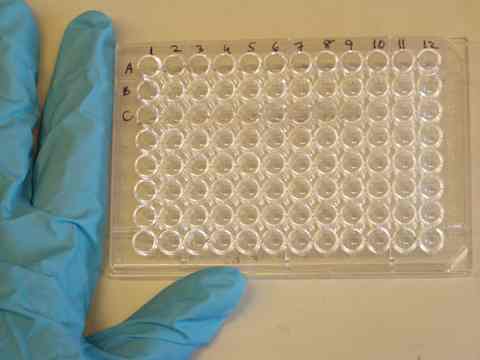
measure the absorbance of the LOV protein in each well of a plate(What a microplate looks like). Because the proteins response
is governed by thermodynamics we have some unpredictability, we don't
know exactly how the solution of protein in the well will respond but we
have a good idea. As time goes on a percentage of the proteins can
degrade or aggregate and cannot interact with light anymore. This is dependent on each engineered variant. This also changes the response.
 The first version of the Chromochord was built on top of a UV-Visible light absorbance based plate reader. As you can see below the Chromochord was of significant size and weight. As you can see it was meant to be played live with music and lights controlled through buttons. I wrote software to interact with the plate reader and interfaced it with an arduino and a custom version of ttymidi I wrote. Layers could be built up with sooperlooper. It is kind of cool. The musical layering idea was inspired by Zoe Keating.
The new Chromochord I built is based on a single wavelength measurement, which can easily be modified do more than one. Most modern plate readers use a bright white light and filters to generate a number of wavelengths. An easy way to give the Chromochord multiple wavelengths would be to use an RGB LED. Currently, it uses an ~460 nm blue LED as that is the wavelength I am most interested in. The current amount of time it takes to measure and filter on 12 wells is <350 ms (almost all of that is software filtering)!!!
24 LEDs: 12 for Excitation of the Protein and 12 for spectroscopic measurement
12 Light Dependent Resistors (LDRs)
1 Arduino Due
Assorted wires and resistors
The LEDs were high intensity Blue LEDs. I used Blue because the protein is both excited and absorbs at around 450 nm. I needed them to generate a significant amount of light in the milliseconds they were flashed on and off so I went for some high intensity ones. I have not measured the lumen output for the flash of light.
If I change anything it will be the LDRs they aren't bad but I think they are the reason I have so many problems gaining stable measurements. I purchased them because originally I was thinking of doing all 96 wells and at $5 a pop for a phototransistor, that's alot of money.
I chose the Arduino Due because it has a 12 bit ADC, which probably wasn't even enough but I had tough luck finding a 12 channel > 12bit ADC that I could soder and using one ADC per LDR I was just too lazy for. I actually thought the 12 bit wouldn't be too bad and it wasn't. I probably could have also used some hardware filters to give my measurement more resolution as my readings were only using a fraction of the actual spectrum.
Here is a link to the Arduino code: Chromocode
The code filters the measurement data, creates baselines and all other sorts of stuff. Then it prints the readings to the Serial port which can be read by any program. We were using Max/MSP. But like with the original Chromochord, one can always route the data to ttymidi on Linux.
I will make another post on the Artistic Installation we did and also post the Max code.
This second version is much faster but cannot be directly played as is. Instead a score is written as 1s and 0s of course and used to control the photoexcitation of the proteins. It allows for much more complicated music to be played.
Here are pictures of the new Chromochord:
The Box
The Guts
Inside the Box
The Chromochord running
Visualizing the Wells and generating the sound using Max
The Chromochord Running
The Audio and Video Chromochord Installation
Thursday, May 2, 2013
What would you give a leg for?
So on my walk home from work I pass by a local bar. The other day I saw one of my friends was bartending and the bar was pretty empty so I decided to stop in for a quick beer and say hi. After a few minutes an older gentlemen came in and sat down next to me and started to chat. I am usually not really into talking to strangers but I was in a open mood. As sports was on the TV we were chatting about them and the conversation came to concussions and Amercian Football and how the players are suing the NFL and the implications of this situation. Are they being paid "X" Dollars(which is way more than your average person) to receive concussions. Is it their job? Are Amercian Football players just entertainers and their job is to hurt and be hurt like Ultimate Fighting? (I know there are college kids who are paying the price of injury without any recompense but lets leave that out of this discussion for now)
We then started talking about if us or someone would turn down hundreds of thousands of dollars if they were told they would receive a few concussions. Sadly, in this world money buys us so much. Not just comfortability but opportunities. The question came to would him or I give up a leg for $1 million. I told him it was a very difficult question for me because $1 million would allow me to pursue my dream of being able to do research and engineering on my own. It would basically fulfill my dream. I don't need a leg to do science or engineering. I have invested so much in my mind. He was a little abashed by my response even though I tried to explain it wasn't out of greed. It was a tough question for me.
Afterward I started thinking about what I would actually give up for my goals and to accomplish the things I want. It sucks that people give up their dreams and passions. It sucks that people don't have something in their life that they would give up a leg for. Or maybe I am just really naive that I would consider it.
I learned long ago that we can't accomplish everything we want in the world. The whole keep your dreams alive is fake and stupid. But with effort and perseverance we can create beautiful things or do beautiful things. Maybe not what we were dreaming of but still beautiful and moving.
If someone told me I would have to give up my leg or I couldn't do science or engineering ever again. I wouldn't even hesitate.
We then started talking about if us or someone would turn down hundreds of thousands of dollars if they were told they would receive a few concussions. Sadly, in this world money buys us so much. Not just comfortability but opportunities. The question came to would him or I give up a leg for $1 million. I told him it was a very difficult question for me because $1 million would allow me to pursue my dream of being able to do research and engineering on my own. It would basically fulfill my dream. I don't need a leg to do science or engineering. I have invested so much in my mind. He was a little abashed by my response even though I tried to explain it wasn't out of greed. It was a tough question for me.
Afterward I started thinking about what I would actually give up for my goals and to accomplish the things I want. It sucks that people give up their dreams and passions. It sucks that people don't have something in their life that they would give up a leg for. Or maybe I am just really naive that I would consider it.
I learned long ago that we can't accomplish everything we want in the world. The whole keep your dreams alive is fake and stupid. But with effort and perseverance we can create beautiful things or do beautiful things. Maybe not what we were dreaming of but still beautiful and moving.
If someone told me I would have to give up my leg or I couldn't do science or engineering ever again. I wouldn't even hesitate.
Chromochord UChicago Video
The project is coming along splendidly. I finished building the new Chromochord and it is badassssss. Been working on developing music with Francisco. We should have something cool for when we do a demo next Wednesday.
Sunday, April 21, 2013
Science Knowledge/Teaching
So this weekend I volunteered to judge a Chicago High School science fair/competition. The people participating were all mostly affluent it was enjoyable and an interesting experience. What I want to comment on is that state of scientific teaching that it appears these kids have had.
Science is not easy. Most Ph.D. scientists have been studying science for around 12 years before they even receive their Ph.D. There are so many people out there who think that science is easy. That one can just make up scientific theories in their spare time if they are "smart" enough. I don't really believe greatly in intelligence though. Just as in sports you have people with lots of natural talent, I am sure there are people that have lots of natural talent with their mind. However, that doesn't mean that someone who trains can't be at the same level or better. Someone who learns and thinks and takes care of their mind just like an athlete would their muscles and body. So what is scientist then? To start out being a scientist one needs to accumulate knowledge. That is the way it is for everything. Is there a chance that someone will be able to write down a random proof that proves P != NP or some such? (http://en.wikipedia.org/wiki/P_versus_NP_problem) Maaaaybbbee but in all likelihood that will never ever happen.
So back to the science fair. These kids know nothing about science. Instead what they are taught is that they should try and "Reject their Null hypothesis." It is sad. Scientists don't sit around trying to reject Null Hypotheses. People don't even mention a Null hypothesis in college besides perhaps a statistics course. The lack of scientific thought and knowledge was somewhat appalling. I am not saying it is this way all across Chicago or even all over the US but for an affluent Chicago competition I expected more. I volunteered with FIRST robotics for two years and it was quite impressive. The things kids can program these days and their computer knowledge and skill is advanced. We have only had personal computers for the past ~20 years and people have been doing molecular biology for the past 50.
Myself as an example. I started programming in High School on my own. Eventually by my senior year they had a C++ class for advanced students. Our biology labs however didn't even have a basic electrophoresis setup. Why? This makes no sense to me. Why are we not teaching younger people advanced science techniques or exposing them to advanced science it is the only way they will learn. Instead of having kids drop out of college to start the facebook. They will drop out to start their own biotech company. "Smart" takes time and it seems in science we are all starting a little further behind everyone else. We are not "allowed" to learn about real science until college. I think this is a big issue. I think science needs to be more accessible. Science knowledge needs to be more accessible.
I don't think this is something that can be easily fixed but requires many/all scientists to believe this is something we need.
There are 16 year olds programming video games and websites and robots and they don't even know what DNA is. I think that is a problem.
Science is not easy. Most Ph.D. scientists have been studying science for around 12 years before they even receive their Ph.D. There are so many people out there who think that science is easy. That one can just make up scientific theories in their spare time if they are "smart" enough. I don't really believe greatly in intelligence though. Just as in sports you have people with lots of natural talent, I am sure there are people that have lots of natural talent with their mind. However, that doesn't mean that someone who trains can't be at the same level or better. Someone who learns and thinks and takes care of their mind just like an athlete would their muscles and body. So what is scientist then? To start out being a scientist one needs to accumulate knowledge. That is the way it is for everything. Is there a chance that someone will be able to write down a random proof that proves P != NP or some such? (http://en.wikipedia.org/wiki/P_versus_NP_problem) Maaaaybbbee but in all likelihood that will never ever happen.
So back to the science fair. These kids know nothing about science. Instead what they are taught is that they should try and "Reject their Null hypothesis." It is sad. Scientists don't sit around trying to reject Null Hypotheses. People don't even mention a Null hypothesis in college besides perhaps a statistics course. The lack of scientific thought and knowledge was somewhat appalling. I am not saying it is this way all across Chicago or even all over the US but for an affluent Chicago competition I expected more. I volunteered with FIRST robotics for two years and it was quite impressive. The things kids can program these days and their computer knowledge and skill is advanced. We have only had personal computers for the past ~20 years and people have been doing molecular biology for the past 50.
Myself as an example. I started programming in High School on my own. Eventually by my senior year they had a C++ class for advanced students. Our biology labs however didn't even have a basic electrophoresis setup. Why? This makes no sense to me. Why are we not teaching younger people advanced science techniques or exposing them to advanced science it is the only way they will learn. Instead of having kids drop out of college to start the facebook. They will drop out to start their own biotech company. "Smart" takes time and it seems in science we are all starting a little further behind everyone else. We are not "allowed" to learn about real science until college. I think this is a big issue. I think science needs to be more accessible. Science knowledge needs to be more accessible.
I don't think this is something that can be easily fixed but requires many/all scientists to believe this is something we need.
There are 16 year olds programming video games and websites and robots and they don't even know what DNA is. I think that is a problem.
Friday, April 12, 2013
Transient Voltage Through Photoexcitation of Metals(Iron?) in Water. (Photoelectric effect?) (Photo-Fenton reaction?)
This sounds crazy I know. I thought it was crazy when I saw it but I have tested it so many times and have shown that it actually works.
I stumbled upon this while working with the light activated protein domain from Oat(Avena sativa) LOV2
You put metal electrodes in ordinary tap water and you see photovoltages. This data is not so precise, I know but I ordered a multimeter I can attach to my computer a few days ago. So once I receive it I can have actual plottable data.
This is very similar to the Original battery except without salt and with light
http://en.wikipedia.org/wiki/Voltaic_pile
Basically what is happening in these electrochemical cells is Atoms are being oxidized in one electrode(anode) and reduced in the other(cathode). So electrons from the oxidized electrode flow to the reduced electrode.
So this is what I tried:
All were measured in 300uL of tap water in a polystyrene plate.
I took two pieces of metals and placed them in the liquid not touching, one higher than the other and connected a multimeter to each electrode.
Steel wire, Steel is an Iron alloy, so it is composed mostly of iron but has ~1.5% Manganese and 0.8% Silicon and other trace elements
(http://www.lincolnelectric.com/en-us/Consumables/Pages/product.aspx?product=Products_Consumable_MIGGMAWWires-SuperArc-SuperArcL-56(LincolnElectric) )
About 10-20mV from one electrode to the other in tap water. This voltage increases over time about 10 mV every 15 minutes. There is a transient photovoltaic action of about 10mV. Repeatable with delay. I think this is the photo-fenton reaction in which the light is photoexciting Fe3+ to Fe2+.
(http://en.wikipedia.org/wiki/Photocatalysis) In the photofenton reaction light produces free radicals producing Fe2+ and OH radical. These radicals should react quickly. But why doesn't continuous light keep a stable voltage? Maybe it is something with my setup.
These transients last for about 1-2 seconds and then the voltage starts to return to the normal value even if there is still light in most cases. I don't quite understand the process.
Copper wire, which is composed from as far as I can tell mostly of copper. Maybe not?
Pretty good acquired the highest voltages from this. >100mV on some occasions.
Stable around 80-100mV.
Electrodes wear out in about 30 minutes
Platinum Electrode
No voltage which was expected as platinum is pretty inert.
Steel and Copper
This is a steel cathode and copper anode.
>400mV and 5uA of current
Light effect transient stays with continuous light. A ~5-10mV decrease is observed after a few seconds of light exposure. However, there is an increase upon long-term light exposure. The voltage was around 500mV after about 5 minutes of light exposure! That's 50-100mV increase from light. crazy! also, upon removal of the light we don't lose much in terms of voltage maybe just a few mV.
~20mV per 10 minutes decrease in voltage that is based solely on the copper. i.e. Switching out the copper brings the voltage back up.
In a solution of table salt(Sodium Chloride, Dextrose, Potassium Iodide, Calcium silicate)
The current increases to between 10-20uA.
I also see transient current increases in response to light.
This solution decreases what I assume is the destruction of one of the electrodes to about 5mV / 20 minutes, which means the electrode has a half-life of about 1 day if the destruction is mostly linear.
Steel and Aluminum Silicon
~40mV
There is a light effect but surprisingly unlike the other light effects this one takes a bit of time before it will work again. Usually when I shine light I see the transient and then it starts to decay and it decays in a few seconds. After it is decayed I shine again and it works to the same magnitude. In this one if I try the same the second time there is much less amplitude in the transient.
Steel and Aluminum foil
~200mV 1uA
I see a nice 10mV change upon light which is alot more stable than in all the other cases. Under continuous light I see a somewhat stable value. However, I think the aluminum is being rapidly oxidized from the increases in Fe2+ so the voltage starts to decay pretty fast. A very small change in the current upon photoillumination.
-------------
Using filters I narrowed down the light wavelength that causes the effect to somewhere between 300 and 450 nm.
It seems like this is some form of the photo Fenton reactionor maybe a Photoelectric effect. I don't know much about this type of photochemistry.
Iron can be photoexcited between those wavelengths.
I know this data is not that exciting at the moment but it was interesting to understand the properties of these metals and see crazy photochemistry. Even in just tap water. Who knew that you could generate voltage and current like this!
I need to scale it up and I want to build a light that works by using rain and the sun! Much cheaper than a solar panel! Can connect in series and it works great but low current. Which means I need a decent electrolyte.
Or what about a piezo-electric light that works by rain?
More studies on electrochemistry coming. I just need to learn more about it.
I stumbled upon this while working with the light activated protein domain from Oat(Avena sativa) LOV2
You put metal electrodes in ordinary tap water and you see photovoltages. This data is not so precise, I know but I ordered a multimeter I can attach to my computer a few days ago. So once I receive it I can have actual plottable data.
This is very similar to the Original battery except without salt and with light
http://en.wikipedia.org/wiki/Voltaic_pile
Basically what is happening in these electrochemical cells is Atoms are being oxidized in one electrode(anode) and reduced in the other(cathode). So electrons from the oxidized electrode flow to the reduced electrode.
So this is what I tried:
All were measured in 300uL of tap water in a polystyrene plate.
I took two pieces of metals and placed them in the liquid not touching, one higher than the other and connected a multimeter to each electrode.
Steel wire, Steel is an Iron alloy, so it is composed mostly of iron but has ~1.5% Manganese and 0.8% Silicon and other trace elements
(http://www.lincolnelectric.com/en-us/Consumables/Pages/product.aspx?product=Products_Consumable_MIGGMAWWires-SuperArc-SuperArcL-56(LincolnElectric) )
About 10-20mV from one electrode to the other in tap water. This voltage increases over time about 10 mV every 15 minutes. There is a transient photovoltaic action of about 10mV. Repeatable with delay. I think this is the photo-fenton reaction in which the light is photoexciting Fe3+ to Fe2+.
(http://en.wikipedia.org/wiki/Photocatalysis) In the photofenton reaction light produces free radicals producing Fe2+ and OH radical. These radicals should react quickly. But why doesn't continuous light keep a stable voltage? Maybe it is something with my setup.
These transients last for about 1-2 seconds and then the voltage starts to return to the normal value even if there is still light in most cases. I don't quite understand the process.
Copper wire, which is composed from as far as I can tell mostly of copper. Maybe not?
Pretty good acquired the highest voltages from this. >100mV on some occasions.
Stable around 80-100mV.
Electrodes wear out in about 30 minutes
Platinum Electrode
No voltage which was expected as platinum is pretty inert.
Steel and Copper
This is a steel cathode and copper anode.
>400mV and 5uA of current
Light effect transient stays with continuous light. A ~5-10mV decrease is observed after a few seconds of light exposure. However, there is an increase upon long-term light exposure. The voltage was around 500mV after about 5 minutes of light exposure! That's 50-100mV increase from light. crazy! also, upon removal of the light we don't lose much in terms of voltage maybe just a few mV.
~20mV per 10 minutes decrease in voltage that is based solely on the copper. i.e. Switching out the copper brings the voltage back up.
In a solution of table salt(Sodium Chloride, Dextrose, Potassium Iodide, Calcium silicate)
The current increases to between 10-20uA.
I also see transient current increases in response to light.
This solution decreases what I assume is the destruction of one of the electrodes to about 5mV / 20 minutes, which means the electrode has a half-life of about 1 day if the destruction is mostly linear.
Steel and Aluminum Silicon
~40mV
There is a light effect but surprisingly unlike the other light effects this one takes a bit of time before it will work again. Usually when I shine light I see the transient and then it starts to decay and it decays in a few seconds. After it is decayed I shine again and it works to the same magnitude. In this one if I try the same the second time there is much less amplitude in the transient.
Steel and Aluminum foil
~200mV 1uA
I see a nice 10mV change upon light which is alot more stable than in all the other cases. Under continuous light I see a somewhat stable value. However, I think the aluminum is being rapidly oxidized from the increases in Fe2+ so the voltage starts to decay pretty fast. A very small change in the current upon photoillumination.
-------------
Using filters I narrowed down the light wavelength that causes the effect to somewhere between 300 and 450 nm.
It seems like this is some form of the photo Fenton reactionor maybe a Photoelectric effect. I don't know much about this type of photochemistry.
Iron can be photoexcited between those wavelengths.
I know this data is not that exciting at the moment but it was interesting to understand the properties of these metals and see crazy photochemistry. Even in just tap water. Who knew that you could generate voltage and current like this!
I need to scale it up and I want to build a light that works by using rain and the sun! Much cheaper than a solar panel! Can connect in series and it works great but low current. Which means I need a decent electrolyte.
Or what about a piezo-electric light that works by rain?
More studies on electrochemistry coming. I just need to learn more about it.
Friday, April 5, 2013
The Good About Science
I think often people express all the bad about science.
I am guilty of it also. Lack of funding. Hard to find a job. Discrimination. All the politics. Hard to publish. Blah blah blah. But what about the good in science. We don't often hear people talking about that.
I love science, I love it. I mean if you read my blog you know this because I spend much of my free time doing weird and random science experiments or engineering or programming projects. The past few days I have been working on some really cool projects, building and developing DIY lab equipment, programming machine learning stuff, optimizing my 3D printer and other extra special projects I will write about soon. It is so much fun, it is so beautiful.
I love science and building stuff it is my heart and soul. I love learning and thinking and contemplating. These things challenge me in such a way that I constantly have motivation to learn more and try harder.
Problems. That is what inspires me. How do I solve this problem? How can I gain/provide more insight on this topic? I constantly think about these things.
Ideas. That is what inspires me. Nothing makes me more excited than a new idea that is complicated enough to challenge me and requires me to learn and gain new skills or combine skills in a new way in order to bring the idea to reality.
Some people do science or do engineering. It is different for me. I am a scientist and an engineer. Someone once asked me what I would do if I was last person left on Earth and I said "I would go to work and do research and it would be nice because no one else would be around." Now I am developing my own personal lab/work space at home so I guess I could just stay home and work.
I am not one of those people who can sit around and do nothing all day or watch TV. I have so many things I want to study or work on or accomplish or fix or develop or discover.
Science shows me the beautiful parts of the world. It allows my life to be exciting without even leaving my chair. Science and engineering and knowledge have given me the ability to discover amazing things and see beauty without traveling to far away places.
Yeah it has been hard work and yeah it sucks sometimes but I won't give it up, I can't give it up.
I am guilty of it also. Lack of funding. Hard to find a job. Discrimination. All the politics. Hard to publish. Blah blah blah. But what about the good in science. We don't often hear people talking about that.
I love science, I love it. I mean if you read my blog you know this because I spend much of my free time doing weird and random science experiments or engineering or programming projects. The past few days I have been working on some really cool projects, building and developing DIY lab equipment, programming machine learning stuff, optimizing my 3D printer and other extra special projects I will write about soon. It is so much fun, it is so beautiful.
I love science and building stuff it is my heart and soul. I love learning and thinking and contemplating. These things challenge me in such a way that I constantly have motivation to learn more and try harder.
Problems. That is what inspires me. How do I solve this problem? How can I gain/provide more insight on this topic? I constantly think about these things.
Ideas. That is what inspires me. Nothing makes me more excited than a new idea that is complicated enough to challenge me and requires me to learn and gain new skills or combine skills in a new way in order to bring the idea to reality.
Some people do science or do engineering. It is different for me. I am a scientist and an engineer. Someone once asked me what I would do if I was last person left on Earth and I said "I would go to work and do research and it would be nice because no one else would be around." Now I am developing my own personal lab/work space at home so I guess I could just stay home and work.
I am not one of those people who can sit around and do nothing all day or watch TV. I have so many things I want to study or work on or accomplish or fix or develop or discover.
Science shows me the beautiful parts of the world. It allows my life to be exciting without even leaving my chair. Science and engineering and knowledge have given me the ability to discover amazing things and see beauty without traveling to far away places.
Yeah it has been hard work and yeah it sucks sometimes but I won't give it up, I can't give it up.
Thursday, April 4, 2013
Machine Learning and Perl
----EDIT TO POST----
To the people who find this post by an internet search I suggest you give up on machine learning in Perl and learn to do it in Python. That's what I did.
---------------------------
Yep, that's correct. I started to do some basic machine learning programming in Perl.
See I had this large dataset that I generated and wanted to understand it better. We were working with someone who was using RandomForest modeling and I wanted to have a better grasp of that so I decided to program a Decision Tree learning program to take a general dataset and map it to a binary effect. I chose a binary effect because non-binary effects are much harder to do especially on a small dataset like mine with ~75 values.
Basically what the program I wrote does is take the whole dataset and calculate binomial probabilities for a given feature value to predict the outcome. This has led me down many streams of inquiry.
How to bin features?
Been thinking of using k-means clustering.
How/If to calculate feature entropy?
I have been having trouble with Information Gain Entropy because some features I use have lots of possible values. Information gain entropy biases to features with fewer values. I could iterate over all possible mutual information values but that could possibly become very problematic with datasets with many features. But probably not.
Is it possible to generalize machine learning?
Kind of but not really. There are so many caveats with every machine learning technique. It cracks me up. I will spend time thinking about about why something shouldn't work only to read about it and find out that it shouldn't work or that there is a bias in the method.
So I wrote a basic machine learning program in Perl that takes binary effects and tries to predict them using the features and states of features that you give it. I used it for trying to find any information as to how or why mutations I made to a protein did what they did. It didn't tell me much besides the fact that many characteristics of each residue determine it's effect on function. Surprisingly BLOSUM62 scores are a really good measure of the effect of a mutation on a proteins function.
The code is a total kludge but I like Perl because of hashes. You can put anything in a hash and do anything with a hash. Very nice. However, the way Perl handles array values vs array references is not very nice.
The code will take a training set of data and find the best predictors for your binary effect it will then attempt to predict data in your prediction set. It will compare the top 3 best predictors for each datapoint to come up with a prediction. It will tell you how often you predicted correctly. Mutual information code is in there but it doesn't use it because my data doesn't have enough points to make mutual information useful.
Decision Tree Code
0-6 on Post Doc emails (1 response)
I think I will blame it on sequestration.
To the people who find this post by an internet search I suggest you give up on machine learning in Perl and learn to do it in Python. That's what I did.
---------------------------
Yep, that's correct. I started to do some basic machine learning programming in Perl.
See I had this large dataset that I generated and wanted to understand it better. We were working with someone who was using RandomForest modeling and I wanted to have a better grasp of that so I decided to program a Decision Tree learning program to take a general dataset and map it to a binary effect. I chose a binary effect because non-binary effects are much harder to do especially on a small dataset like mine with ~75 values.
Basically what the program I wrote does is take the whole dataset and calculate binomial probabilities for a given feature value to predict the outcome. This has led me down many streams of inquiry.
How to bin features?
Been thinking of using k-means clustering.
How/If to calculate feature entropy?
I have been having trouble with Information Gain Entropy because some features I use have lots of possible values. Information gain entropy biases to features with fewer values. I could iterate over all possible mutual information values but that could possibly become very problematic with datasets with many features. But probably not.
Is it possible to generalize machine learning?
Kind of but not really. There are so many caveats with every machine learning technique. It cracks me up. I will spend time thinking about about why something shouldn't work only to read about it and find out that it shouldn't work or that there is a bias in the method.
So I wrote a basic machine learning program in Perl that takes binary effects and tries to predict them using the features and states of features that you give it. I used it for trying to find any information as to how or why mutations I made to a protein did what they did. It didn't tell me much besides the fact that many characteristics of each residue determine it's effect on function. Surprisingly BLOSUM62 scores are a really good measure of the effect of a mutation on a proteins function.
The code is a total kludge but I like Perl because of hashes. You can put anything in a hash and do anything with a hash. Very nice. However, the way Perl handles array values vs array references is not very nice.
The code will take a training set of data and find the best predictors for your binary effect it will then attempt to predict data in your prediction set. It will compare the top 3 best predictors for each datapoint to come up with a prediction. It will tell you how often you predicted correctly. Mutual information code is in there but it doesn't use it because my data doesn't have enough points to make mutual information useful.
Decision Tree Code
0-6 on Post Doc emails (1 response)
I think I will blame it on sequestration.
Tuesday, April 2, 2013
Solidoodle 3 Review! My first 3D printer.
Yep, that's correct I purchased a 3D printer. The Solidoodle 3.
I was in the market for a 3D printer because I had saved up a little bit of money and wanted one that was built and tested and under $1000 and I knew I would receive it in less than 2 months or so. I was thinking about the Robo3D they had a kickstarter campaign and were priced about $650 but they really failed to post any videos of a finished product and the quality of the prints. I decided on the Solidoodle 3 which had a delivery time of 6-8 weeks at the time, it has since changed to 8-10 weeks. I will be honest, their customer service is shit. I purchased the printer at $799 and a few spools of ABS filament and the total came out to about ~$950 with shipping. I received one email from them when I purchased it and that went to my spam folder so I didn't even notice it till after I emailed them asking what was going on. Then I received an email that it shipped 7 weeks later. I emailed them in the interim, actually a few days before it shipped to ask on the status and the person who emailed me back said, "Delivery time is 8-10 weeks." If they can't/don't even check to see when a customers item will be shipped that just spent almost $1000, that is pretty shitty. On top of that. The printer came with no instructions. Their website makes really no mention of using Linux and Solidoodle 3 besides to install some software that they don't even provide updated config files or parameters for. Actually, I couldn't make it work initially and posted on the Solidoodle Google Group asking about it. After, I figured out how to make it work and posted what I did someone form the company asked me for the config file I used! haha. Seriously? You don't even know how to make your own printers work?
3D printers are not ready for the average non-technically inclined person to use. I imagine most other printers in a similar price range are the same way. From what I see and read it appears that printers in the $2000+ price category are somewhat more beginner friendly and non-technical.
Technically documentation is extremely lacking and up-to-date tutorials and guides are also. The Solidoodle is decent piece of hardware but it needs so much more to make it even remotely a good investment.
As for printing.
Nothing sticks to the bed unless it is huge. That is a problem because huge things tend not to print well due to lack of temperature control and the bed only heating to ~80C when they say on their website that it should go to >100C. They admitted on Solidoodle Google Group that they were just too lazy to change this on the website.
Well I am sure I will have much fun with this thing printing off stuff for my projects. However, I don't think 3D printing is ready for the general public commercial market just yet unless one is willing to pay > $2000.
My first successful print. Pint glass for scale obviously.

I have created a Beginner's Tutorial if you have a Solidoodle 3 and it can be found here:
http://doitourselfscience.blogspot.com/2013/07/solidoodle-3-beginners-tutorial.html
Monday, April 1, 2013
Whoa
So many cool things I have been working on lately. I have been spending so much time doing experiments and learning and coding that my writing has not been catching up. Hopefully I will have some free time this week when I am not obsessively thinking and working on a project.
Still no Post Doc. A few people have offered me jobs here at the University of Chicago. One of my Professor friends Tao Pan is top of the list. We will see. I just don't see why/how people don't reply. I mean seriously. It is very weird how these people treat other human beings when not long ago they were in the same position. Weird. I wish I could vent more about it but I guess I don't really care enough to. Too many cool things I am working on.
Been testing my memory every morning without fail. It is very difficult to try and figure out memory techniques. I can't tell if my memory is improving much. Strangely (why do adverbs seem so weird?), I can remember 10 digits by looking at them for less than 5 seconds by chunking them into 3s and a single (111 111 111 1). But 11 numbers is significantly more difficult for my mind. I have been trying to figure out a simple way to overcome this without resorting to extension mnemonic devices. Difficult for the time being.
I have drastically reduced my drinking and my mind has been working better than it has for the past 5 years. I don't even have enough time and energy to keep up with all the ideas and learning I want to do.
Hopefully, new fun experiments/ideas will be posted soon.
Still no Post Doc. A few people have offered me jobs here at the University of Chicago. One of my Professor friends Tao Pan is top of the list. We will see. I just don't see why/how people don't reply. I mean seriously. It is very weird how these people treat other human beings when not long ago they were in the same position. Weird. I wish I could vent more about it but I guess I don't really care enough to. Too many cool things I am working on.
Been testing my memory every morning without fail. It is very difficult to try and figure out memory techniques. I can't tell if my memory is improving much. Strangely (why do adverbs seem so weird?), I can remember 10 digits by looking at them for less than 5 seconds by chunking them into 3s and a single (111 111 111 1). But 11 numbers is significantly more difficult for my mind. I have been trying to figure out a simple way to overcome this without resorting to extension mnemonic devices. Difficult for the time being.
I have drastically reduced my drinking and my mind has been working better than it has for the past 5 years. I don't even have enough time and energy to keep up with all the ideas and learning I want to do.
Hopefully, new fun experiments/ideas will be posted soon.
Sunday, March 24, 2013
Intelligence and Creativity and Memory
What defines intelligence? or creativity or memory? Is there a way that we can increase our own? How much effort should one invest in bettering their intelligence and creativity as opposed to just using it?
I think about these things often. Having an interesting idea and implementing it is really fun and exciting. Both can be difficult. Ideas are only as good as ones ability to implement them and if you cannot have ideas it doesn't matter how great you are at implementing them.
I have been trying to track when I have my most interesting ideas. It seems that they occur when I am dramatically exposed to a large amount of new stimuli or when I have time to think. I have been having trouble with exposing myself to new stimuli. This is a hard task. Where does one look? I try and read science journals that are out of my field but I am having trouble with this. As for the time to think I have a reminder on my Google Calendar to take 5 minutes a day and try and think of something new. I take 5 minutes and relax and close my eyes and listen to Zoe. It works ok but I think I definitely need the fresh stimuli.
Is there a better way to think? Is the way I think in general about things inferior to a possible different way of thinking? This is really hard to quantify. I often try to modify my thought patterns to be more productive. I have tried to teach myself(very little effort) to be able to hold two things in my mind at one time(There should be an old blog post on that here) . I probably should put more effort into that. Thinking is a very abstract idea. Sometimes my brain is so good at processing complex thoughts and my memory works very well, other times it does not. How do I make things function optimally all the time? Difficult to figure out. I have started drinking alcohol much less. Hmmm but I don't really have many more ideas?
One thing that I can quantify that is related to intelligence and creativity is memory. I have been listening to the audiobook Moonwalking with Einstein. I do prefer paper books but I recently found out I had an audible.com account active for a year so I have lots of credits to use... Anyways, as most things do it has inspired me more to better my memory. For the past year or so I have used Memory Trainer an android app. It has taught me interesting things about my memory and has also improved my memory to where I can non-mnemonically memorize sequences of numbers up to around 10 digits fairly easy by chunking. It is free and probably just as fun as Angry Birds or some such game though I have never played Angry Birds so I might not be the correct person to ask. I think by learning some mnemonic memory techniques I can create an overall better memory for the rest of my life.
I decided I would take 5 minutes or so everyday and practice memorizing strings of numbers. I wrote a small program in Perl to allow me to test myself (http://pastebin.com/nyJWs0e3).
I really want to be able to think the best I possibly can. Nothing makes me more excited than having an interesting idea and executing it as you can probably see by my blog. I think the complexity and originality of the idea are what make me excited. These two things require my best creativity, my best ability to generate new ideas and my best brain function to think about complex things. I wish these came easy to me. I think I need to take more time and just relax and think and calm down and experience. Think. Creative. Execute.
If only I was smarter.
And after just sitting and staring off into space for no reason I just had a fun idea!
Do people make more spelling mistakes when they are happy or when they are sad and can we figure this out using twitter?
I think about these things often. Having an interesting idea and implementing it is really fun and exciting. Both can be difficult. Ideas are only as good as ones ability to implement them and if you cannot have ideas it doesn't matter how great you are at implementing them.
I have been trying to track when I have my most interesting ideas. It seems that they occur when I am dramatically exposed to a large amount of new stimuli or when I have time to think. I have been having trouble with exposing myself to new stimuli. This is a hard task. Where does one look? I try and read science journals that are out of my field but I am having trouble with this. As for the time to think I have a reminder on my Google Calendar to take 5 minutes a day and try and think of something new. I take 5 minutes and relax and close my eyes and listen to Zoe. It works ok but I think I definitely need the fresh stimuli.
Is there a better way to think? Is the way I think in general about things inferior to a possible different way of thinking? This is really hard to quantify. I often try to modify my thought patterns to be more productive. I have tried to teach myself(very little effort) to be able to hold two things in my mind at one time(There should be an old blog post on that here) . I probably should put more effort into that. Thinking is a very abstract idea. Sometimes my brain is so good at processing complex thoughts and my memory works very well, other times it does not. How do I make things function optimally all the time? Difficult to figure out. I have started drinking alcohol much less. Hmmm but I don't really have many more ideas?
One thing that I can quantify that is related to intelligence and creativity is memory. I have been listening to the audiobook Moonwalking with Einstein. I do prefer paper books but I recently found out I had an audible.com account active for a year so I have lots of credits to use... Anyways, as most things do it has inspired me more to better my memory. For the past year or so I have used Memory Trainer an android app. It has taught me interesting things about my memory and has also improved my memory to where I can non-mnemonically memorize sequences of numbers up to around 10 digits fairly easy by chunking. It is free and probably just as fun as Angry Birds or some such game though I have never played Angry Birds so I might not be the correct person to ask. I think by learning some mnemonic memory techniques I can create an overall better memory for the rest of my life.
I decided I would take 5 minutes or so everyday and practice memorizing strings of numbers. I wrote a small program in Perl to allow me to test myself (http://pastebin.com/nyJWs0e3).
I really want to be able to think the best I possibly can. Nothing makes me more excited than having an interesting idea and executing it as you can probably see by my blog. I think the complexity and originality of the idea are what make me excited. These two things require my best creativity, my best ability to generate new ideas and my best brain function to think about complex things. I wish these came easy to me. I think I need to take more time and just relax and think and calm down and experience. Think. Creative. Execute.
If only I was smarter.
And after just sitting and staring off into space for no reason I just had a fun idea!
Do people make more spelling mistakes when they are happy or when they are sad and can we figure this out using twitter?
Subscribe to:
Posts (Atom)