Tuesday, February 5, 2013

Using a Radiator to Generate Electricity Part 2


So part of Sunday I spent soldering together a bunch of those TEC1-12706 peltier devices.


And then for lack of a better idea I duct taped them to the thermal blanket and put them on the radiator.


Much to my great surprise nothing happened. hahahah. The main problem is temperature differential. Thermoelectric generators or peltier devices work by temperature differential between the two sides. Once the peltier devices equilibrate and heat is not being released faster then it is stored the whole device becomes the same temperature, there is no temperature differential and no voltage. Well that is a lie kind of.

I was able to measure 0.324V from 12 of these devices, haha. I really need a way to dissipate the heat.

On another note. I watched the movie Seven psycopaths this weekend. It was really good. It was really original and interesting. You should check it out.


Oh yeah, my new goal is to not drink so much on Friday so I can do more work on Saturdays. Going to be hard though because drinking is soooo fun! Dahhh.

I also signed up for the DARPA spectrum challenge. I don't know if I will do it but I signed up. They are super sketchy about the details. They sent me an email

"Thank you for registering for the DARPA Spectrum Challenge.  This email is to inform you that the qualification period will begin no earlier than Sunday, Feb 10, 2013.  Several days before the qualification period begins, you will receive another email informing you of the exact start date/time.  Detailed instructions for completing the qualification exercises will be sent to the team leaders at the start of the qualification period."

haha. Whatever that means.


Sunday, February 3, 2013

Predicting Protein Secondary Structure

Shit, I really have lots of projects I am working on maybe too many, haha.
The lab I work in, Tobin Sosnick's Lab at the University of Chicago studies protein folding and protein structure prediction. Sorry that I am going to skip over most of the stuff but the general feature I am going to focus on is predicting secondary structure.

Proteins form different secondary structure based on sterics, i.e. space occupation and also neighbor effects, how their neighbor's interactions effect them. Our lab use a statistically potential for this derived from a library of trimers culled from the PDB. It works pretty well and they have published papers predicting structures using it. However, I felt that maybe this library could be improved because obviously, the known structures don't contain all the possible angles available for a given sequence of amino acids or the library probably doesn't even contain all possible combinations of sequence. I thought a good way to remedy this would be to use molecular dynamics simulations. In this vain I attempted to see if I could predict the secondary structure of a 3 residues combination in a protein. I thought it would be easy. I could just simulate every 3 residue combination, I mean it is only 20^3 = 8000(20 amino acids, 3 residues).

I started with alanine tripeptide. I used my home computers and GROMACS because it is easy to script, runs fast and works great! Most of the peptides were simulated for 10-20 nanoseconds using the OPLS-AA forcefield with tip4p water model.


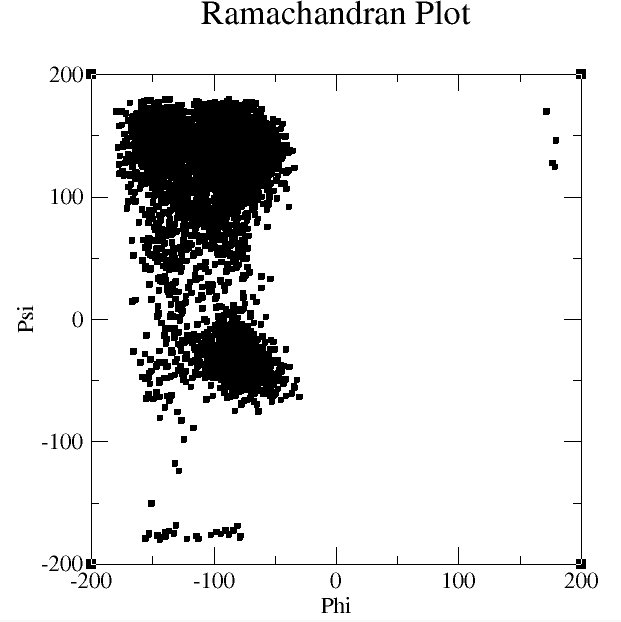
So if you don't know anything about ramachandran maps, click here. Well I expected that this Alanine tripeptide would look alpha helical. So many studies have been done on alanine and it has strong helical propensities. The angles of phi,psi space that correspond to the helical region are around  -75ish(Phi), -50(Psi). As you can see the simulation did not reproduce any of this hahaha. Damnit.

So I figured that maybe it was that there was a length issue. That the forcefield in the simulation could not recapitulate the physical properties without more residues to interact. So I switched to glutamate (~ same helical propensity as alanine, i.e. alot) and ran four, five and 6 residue simulations.

4 GLU

5 GLU

6 GLU


NICE! What we can see is that as we increase the number of residues the simulations becomes more and more like what would be predicted. Unfortunately I don't think there are many? Any? (Wel lto my surprise I just tried Blast and there are alot of proteins with 6 glutamates... Damn... haha).

Anyways, I wanted to try and predict a sequence that a secondary structure propensity was not well know or that the Sosnick lab could not predict well but one in which there was a structure in the PDB so I know if my prediction was correct or not. I random searched the PDB for EIYYINH because I wanted a sequence of at least 6 residues. Looking at the combination of 3 residue predictions of EIYYINH from the Sosnick server we see that it would mostly classify it as alpha helical with slight beta sheet preferences.


EIYYINH


My simulations however show a very strong beta sheet preference with other stuff throw in probably for the residues near the end of the chain. This what is in the structure!! Beta sheet structure generally has Phi, Psi angles  in the -125ish(Phi), 150ish(Psi) region. http://www.rcsb.org/pdb/explore/remediatedSequence.do?structureId=2L4J

YAY!
Really cool.
Caveats: this does not man I can predict structure just the secondary structure preference of 6 residue regions of proteins. The hard part is actually folding it into a 3-dimensional structure. I was thinking of a sliding window protocol to simulate a protein and then see if it could pieced together with maybe throwing in some energy functions to combine it and fold it. That seems like alot of work and I don't feel like doing it. I am happy with my result and my hypothesis that maybe their trimer library could use  more sampling.

No, I have not told them. I don't think they really care, hah. It was just for fun anyway and to test my idea.

Tuesday, January 29, 2013

I think my head is falling off

Yeah, I think my head is falling off and I can't sleep! Motha fucker! Someone help me sleep. I think I am going to start taking medication. I used to not be able to sleep but now I often walk up for hours in the middle of the night.

I spent Saturday recovering from staying up till ~5am on Friday. From drinking not from insomnia, haha.

I spent Sunday learning gnuradio and about RF communication because me and some friends were thinking about competing in the DARPA spectrum challenge ( http://dtsn.darpa.mil/spectrumchallenge/Default.aspx ). I learned alot about one way radio communication and error checking and error correction. I did alot of low level network programming when I wrote IP Sorcery and learned so much about networks and shit when I worked for Motorola's iDEN group in the early 2000s. The internets has much different networking we use TCP/IP for most things but one would think that one way communication protocols would be much better due to lack of interference or data corruption?

Anyways, don't know if I will participate in the challenge. I have learned a whole bunch and it has given me some crazy ideas about using wireless induction in cells. Would be really cool to test if I end up doing my Post Doc with Bozhi Tian.

Made up a figure for my Language analysis paper and started writing it up a bit.

Finished my real paper that we are sending to PNAS and almost finished another one that we are going to send to JACS (just need to do some formatting stuff and grammatical stuff).

I think my biggest problem at the moment is finishing things I have an idea and then immediately start to work on it dropping my other projects. This means that projects tend to not be finished. I need to learn that if I want to start a new project I need to finish an old one first and maybe that will push me to finish more things.

And sleep. Yeah I think sleep will help also.

Been writing and coding to this alot:

Thursday, January 24, 2013

Applying for Post Docs

Applying for Post Docs is strange because one is supposed to take on the whole "Look at me. You want me!" mentality which is kind of awkward and absurd but I guess, needs to be done so people know who they are hiring. I am actually attempting the opposite approach, which is "Hey look at me, I am strange and awkward." haha. It actually takes alot of the pressure off and because I am strange and awkward I don't feel bad about it. I figure people need to know what they are going into with me as much as I do with them. Anyways, on to the story.

So yesterday I sent out a Post Doc email to someone at Haaavaaadd, it was the opposite of professionality but again, that's me.
It went something like this with names and identifying information removed:

--------------------------------------------------------------
Subject: Fun Science == Foo + Josiah

Hey Foo,
Hah, Sorry about the cheesy subject line I was just excited to write you. My name is Josiah Zayner, I am a Ph.D. student in Biochemistry and Molecular Biophysics in Tobin Sosnick’s lab at the University of Chicago and I plan to graduate sometime before the summer. I was wondering if you were looking for Post Docs to work in your lab? Actually, to be honest I have been a fan of your work for a while. I study LOV(Light-Oxygen-Voltage) domains and one of the properties is that upon light absorption there is an intersystem crossing from a singlet state to excited triplet state. I was trying to figure out how to use electrostatic interactions from amino acid substitutions or metal ions to modify the photocycle and read about you using those nano magnetic fields. Thought it was super cool. Then I met Bar at the Photosensory Gordon Conference and I just recently saw X give a talk on his work here at UofC for a faculty interview and! I was talking to Bozhi Tian yesterday(do you know him?) and he said I should definitely email you. I have always been a little intimidated by your lab but have decided that I might as well write you. Honestly, I like how your research combines so much, engineering, programing, biochemistry, biology, physics. That is kind of how I approach my research. I like to find a cool idea and run with it, not limiting myself to specific techniques.
As I mentioned, I work on light activated LOV domains. I have been studying them using lots of spectroscopy (UV, CD, NMR, FTIR) and even more protein engineering and mutational analysis, to determine how the light activation chemistry and thermodynamics work and how to make other proteins light activated. In a relative short period of time I have been able to uncover the mechanisms and chemistry of how LOV domains function and apply this to novel optogenetic tools. My skills however are not limited to Biochemistry and Biophysics, I can program in multiple languages (C, Perl, PHP and smatterings of others including ASM) and for multiple microprocessors including TI and AVR. I am author of IP Sorcery an open source network engineering program of tens of thousands of lines of code written in C and part of a number of Linux distributions. I have autodidactic electrical engineering skills and have experience reverse engineering electronics and have accomplished projects such as building an accelerometer based computer mouse (see http://sosnick.uchicago.edu/people/jz.html or if you're really bored http://zaynertech.blogspot.com) and also inventing a wireless cell density spectrometer that sits in the cell culture. I built a prototype and tried to patent it through UChicago Tech though I was unsuccessful; they said the IP space was too small, HAH. However, the thing I am most proud of is the Chromochord, a biosensor that functions as a musical instrument. The protein functions as a kind of pulse width modulated digital output. Using light one modulates the absorbance of the engineered LOV domain and determines the note played. I recently received $2500 fellowship from the University of Chicago to work on further development of this device. I know lots of this isn't directly related to your work but I guess I am just trying to give you knowledge about my skills and loves and hopefully in the process impress you ever so slightly if I may.
Overall I think we both would gain alot from working together. With my biophysics/biochemistry, engineering and programming skills I imagine we could execute some pretty amazing projects. Attached is my CV with one caveat, I am days? away from submitting another first author paper to PNAS (waiting for a collaborator to send me a supplementary figure AGG!) and a month or two? from submitting two more, one from a collaboration that was just finished when I was a visiting researcher in Amsterdam over the summer and the other, an almost finished manuscript from a project I worked on alone in the lab.

Sorry for the longish email. Josiah Zayner
------------------------------------------ 
 
 
 Yeah, yeah I know The email is a little over the top. Maybe? I was actually just trying to be honest and myself. The guy on his website portrays himself as this fun guy. This was his response:

--------------------------------------------------------
Dear Josiah,
    Thank you for your interest in my laboratory.  Unfortunately I do
not have any positions available.  I wish you the best of success in
your search for a research position and in your future research
career.
   
Best wishes, 
Foo
------------------------------------------
 
I mean maybe he receives 20 of these emails a day and copies and pastes a response because maybe he doesn't have any more space in his lab. It was just weird to feel like cattle. All I hear from PIs is that they hate when people send them some copy and pasted email for a Post Doc. But when potential Post Docs spend an hour writing you an email (I probably spent 10 minutes figuring out if the subject should be: Fun Science = Foo + Josiah, Fun Science && Foo + Josiah, Fun Science == Foo + Josiah, hahaha) and receive a copy and pasted response of two sentences? what do people expect me to do? Spend even more time on an email I know someone won't read?

It makes one even more jaded about scientists. Not much one can do but keep trying harder. Wheew the good thing is I was going to make the email also be an interactive Perl script, HAHAHA. What a cool email that would have been for such a shitty response.


Monday, January 21, 2013

Using a Radiator to generate electricity

So I little while ago I came up with the idea of connecting a bunch of thermoelectric peltier devices together and putting them on top of a radiator and using it to generate enough electricity that I can plug things into this device.

Pretty simple actually. Find a DC to AC converter, they use these in cars for making 12v DC into 120v AC. So basically now all I need to do is be able to generate 12v DC from these peltier devices.

If you are not familiar with peltier devices, they are actually super cool. They use the Seebeck effect to generate eletricity. Basically it is that when there is a temperature difference charge carriers will diffuse from the hot to the cold and likewise. Using semiconductors if we can make the diffusion of the carriers occur at different rates and gain charge separation we can create a voltage.

So I bought a couple peltier devices from eBay, from China and tested them out just by touching them to the radiator. Now the peltier works by temperature difference I know but it was just tests. I found I could measure about 0.3v DC from a TEC1 12706 without any fans or any help creating a better temperature differential. So if I need 3 units per volt and and 12 volts, that's 36 units at about $3 each which is more than I want to spend. Basically, I am hoping I can create a large enough temperature differential that I can make due with 12 or 20 or something.

I currently have 12x TEC1 12706 and 2x TEC1 12710.
I also bought an emergency thermal blanket so I can just drape something over the radiator.


I tested the peltiers in series and they seem to work fine now I just need to solder them all together and duct tape? them to the blanket. Updates coming soon.


Sunday, January 20, 2013

Weekends

I haven't been updating much on weekends and not because I haven't been doing much. I guess I am just not motivated enough to post stuff. Also, probably because I am slightly hungover.

I have not been able to sleep well lately so I decided that from now on I am not going to sleep until I am extremely tired. It works kind of well I guess...

Been studying alot about Stochastic equations in game theory and population dynamics. Trying to piece together Modern Game Theory. I am finding too many differential equations mixed with linear algebra and I am just like daahhhh, Why can't we just do simulations?

Oh yeah, when I was talking about units moving in gaussian distributions that is basically diffusion, HAH.

I love diffusion and Maxwell's Ratchet I want to build something based off of diffusion/brownian motion. I want to build a calculator (this is kind of a joke I was just day dreaming today). You have a solution and it contains different sized magnetic particles. That are all connected to an electromagnet. When you try and do a calculation it drops the particles and then allows them to diffuse. Based on the mean squared distance different size beads diffuse over say 1 hour you have your answer. The calculator works by changing the temperature to increase or decrease diffusion rates. Ratios of different sized beads at different distances can be mapped back to an actual integer value. That would be fun to build haha. Then to restart you activate the electromagnet so they all have the same initial start position.


Friday, January 18, 2013

Game Theory

Games of Life are really interesting and very simple but it seems to be a field somewhat lacking. With the computational power and the minds we have today why are people stuck on things such as Conway's Game of Life?

Yesterday, i spent lots of time reading on game theory and thinking of different ways to invite new games. The most cool thought experiment game I found was The Pirate Game . I really like the logic and reasoning behind the results.

Ok so what to do.. I was thinking about applying Statistical Mechanics to decision making processes and seeing how that led to self-organization or equilibrium behaviour. Simulated actions would be described by probability distribution. The problem is I keep thinking that I am just coming back to molecular dynamics.

Strategies is also an interesting part of Game Theory. As in finding optimal strategies for simple games.

I am more inclined towards the simulation part though. I just have not been able to figure out how to distill things down to a simple simulation.

Conway's Game of Life was interesting to people because it only had 4 rules even though they were completely arbitrary:

  1. Any live cell with fewer than two live neighbours dies, as if caused by under-population.
  2. Any live cell with two or three live neighbours lives on to the next generation.
  3. Any live cell with more than three live neighbours dies, as if by overcrowding.
  4. Any dead cell with exactly three live neighbours becomes a live cell, as if by reproduction.
I guess it would be interesting to find out how many rules are needed for self-organization. I guess the problem with these games is that there is really no probabilities or random variables. There are sets of defined variables and that is it.
How much randomness or stochasticity would it take to ruin a self-organized system?
 What does it take for a self-organized system to stay self-organized even with X amount of noise or stochasticity?

I need more time to think and maybe more time to drink. It's Friday and almost time for graduate student seminar. 

Thursday, January 17, 2013

What ISO actually produces in Picture Quality

I finally found it:
http://www.dpreview.com/reviews/nikon-d3200/12

For my spectrophotography I wanted to find out what ISO and different values actually mean for picture quality and I found a website that has it!
I am stuck between the Nikon D3200 ~$600 and the Nikon D3100 ~$300. I guess I could test them out and if they don't work well just return them but then I can't buy them off of eBay and eBay saves some money. Well D3100 is like $300 on eBay and about $475 on Amazon! The D3200 is about the same on both unless I troll eBay seriously.

Hmmm tough choice...

A Heated Hoody? Hoodie?

Hoody sounds like a hoodlum but I will go with it.

For Christmas I built my brother a heated hoody it ended up costing around $100 but it is pretty badass.


4x 5x15cm Heating Pad  @ $4.95 = $19.80
https://www.sparkfun.com/products/11289

1x Wearable Keypad @ $12.95
https://www.sparkfun.com/products/10411

8x 2500 mAh NiMH Battery - AA @ $2.95 each = $23.60
https://www.sparkfun.com/products/335

1x NiMH Battery Charger @ $7.95
https://www.sparkfun.com/products/10052

2x Battery Holder - 4xAA Square @ $1.95 = $3.90
https://www.sparkfun.com/products/552

1x N-Channel MOSFET 60V 30A @ $0.95
https://www.sparkfun.com/products/10213

1x Arduino off of eBay from China or something @$13

1x Hoody @ $25

I generally prefer buying stuff on eBay or Digikey because the prices are much cheaper than SparkFun but they had that wearable keypad and I wanted shipping in a reasonable amount of time so I went for it. Also could have separated the ATMega from the Arduino and used it as a standalone but didn't feel like spending the time to do that to save $10.

Basically the way the jacket works is that there are two pads in front and two pads in back. The wearable keypad controls the temperature through the PWM output and the MOSFET. The MOSFET is for switching the control voltage/current to the heat pads. This is needed because the Arduino I/O has a 40mA max current and we need alot more, the Heat pads draw ~700mA at 5v.

Schematic:


Arduino code:
http://pastebin.com/hDat8LC0


Github

I wanted a place to store all my code in an easy readable format so I thought I would checkout out Github... HAH

It is a complex subversioning system that I could fucking care less about. I just want to upload code not add, init, commit. Seriously...

I found this and yeah that is how complicated it is...


Wednesday, January 16, 2013

In Memory of Aaron Swartz I found this on Pastebin

http://pastebin.com/Q3AzAZ0Q

Steganalysis

I found this sketchy looking posting:
http://chicago.craigslist.org/nwc/zip/3542750346.html

It has to be some kind of code or somebody who wants to murder someone? Anyways, I was looking for a decent Steganalysis program online, let me rephrase that. I was looking for a functional steganalysis program online and could not find one.

Am I bored enough to write one? Hmmm

Really, the person who is trying to give away expired coffee in their freezer is sketching me out.

Tuesday, January 15, 2013

Units

A friend has queued me in on cellular automata.
https://scimusing.wordpress.com/2013/01/14/sunday-project-one-dimensional-cellular-automata/

I don't like to call them cells because these "cells" can actually represent anything so I guess I will refer to them as "units". The first interesting hurdle I have come to is how do two of these units interact. They have a basic function i.e. moving around an xy plane and then happen to try and occupy a space that either another unit occupies or the same space another unit is trying to occupy at the same time. What to do?

There is a simple answer. The interaction either causes something to happen or it does not. Simple. But the interaction can be slightly more complex than that. Say we are talking about proteins then we can say, the interact either effects the Boltzmann distributed state of the protein or not. How much? Do I really want to give each unit a distribution of states akin to the partition function?

What about ion diffusion? Can I recapitulate ion diffusion to the extent that I can make a self-organizing system? I guess that is basically what molecular dynamics tries to do but I guess I am trying on a simpler level.

I think I need to setup a goal for these units and then give them choices and figure out how simple systems solve problems. How they communicate.. &c.

I know everyone hates Perl but go cry to your mommy here is the basic outline code I am thinking about:


#!/usr/bin/perl


# $grid[256][256];

$grid[0][2] = 5;

print "$grid[0][2]";

for($a = 0;$a < $numcells;$a++)
{

  $x = int(rand(255));
  $y = int(rand(255));
  $grid[$x][$y] = 1;
}

for($b = 0;$b < $rounds;)
{
  for($gridx = 0;$gridx <= 255;$gridx++)
  {
    for($gridy = 0;$gridy <= 255; $gridy++)


    {
      if($grid[$gridx][$gridy] == 1)
      {
        $randx = int(rand(2));
        $randy = int(rand(2));
        $grid[$gridx][$gridy] = 0;

        switch($randx)
        {
           case 0:
           case 1:
           $gridx++;
           case 2:
           $gridx--;
        }

        switch($randy)
        {
           case 0;
           case 1:
           $gridy++;
           case 2:
           $gridy--;

        }
        if($grid[$gridx][$gridy] == 1)
        {
          #what to do if someone is already here?
        }
      }
    }
  }
}